Main

October 21, 2010

Narrative structure in CRPGs

I just picked up Fallout: New Vegas, which despite some annoying bugs (the most vicious of which is a problem where my quicksave files disappear when I relaunch the app) is a lot of fun and a good continuation of the Fallout saga. But this post isn't really about that; it's about how CRPGs structure narrative.

F:NV got me thinking about this because it's fairly natural to want to contrast it with Fallout 3, let alone Fallout 1 & 2. But Fallout 3 is an odd game, heritage-wise, because on the one hand, it draws deeply from the narrative structure pioneered by the Elder Scrolls games, like Daggerfall or Oblivion. On the other hand, it's tonally a pitch perfect successor to the original Fallout franchise. And yet, at least in terms of narrative influence, Fallout 1 can pretty directly trace through all the way to games like Mass Effect. (Fallout 1 was the impetus for the Black Isle studios, the Interplay division that revitalized CRPGs in the 90s, and led to a little game called Baldur's Gate.)

So what am I talking about when I talk about narrative structure? Really, I'm talking about the gameplay devices that are used to get you through a finite plot while still providing the illusion of free will for your game avatar. After all, CRPGs are limited in scope based on art, voice, and text all put together before you even start playing the game -- but the social activity they are meant to emulate is much more flexible. So it's important to CRPGs to make it feel like there's always more beneath the surface, even if there isn't.

So here are some thoughts on common approaches to this problem. The labels are for convenience and for reference points -- I'm not claiming all JRPGs behave like I describe, or that only Bioware has a lock on the "Bioware style" I describe.

JRPG Style

Once could alternately call this the "Final Fantasy" style, although it's held true for many of the JRPGs that I've played. These games are characterized by colorful characters, vast sweeping panoramas, and bizarrely impassable hedges. Like more first person shooters, this style of CRPG relies on spectacle to distract you from the inability to explore. Exploration, if it exists, is usually in the context of narrow spurs off of dungeons that contain some collectable item, rather than new story paths. Subplots are almost non-existent.

Bioware style

The Bioware style -- which is also really the Fallout 1 style -- is characterized by major quest hubs. There is sometimes gating between hubs; for example, a major quest in the intro area you must complete before you can essentially leave the tutorial. Gating may or may not exist for the interior nodes (games from Bioware itself are almost clichéd for having a starting hub, three interchangeable hubs in the mid-game, and then an end sequence) and then there is usually a conclusion area that locks off previous areas.

In each of these hubs, there are usually multiple quests and storylines. Only one storyline tends to exist pre- and post-hub though, which is typically the "main quest." This quest will usually also provide the breadcrumbs that get you into this area, and then conversation with NPCs will tend to drive the discovery of smaller, self-contained stories that illuminate aspects of the hub, or introduce you to new companion NPCs.

This style of game is less likely to keep you on a specific path (Fallout 1 had a very large explorable area, for example), but it's still not always the case that if you see something you can travel to it and explore it. (Jade Empire, for example, had forests where you could not venture off the path.)

Bethesda style

The Bethesda style is arguably the most daunting. In Daggerfall (I can't speak to Arena, although I gather it was a simpler variant on Daggerfall), story was almost nonexistent -- or at least largely left to the player's imagination. There were several stories, which mostly consisted of breadcrumbs to get you into dungeons, but they are almost never directly connected.

Oblivion and Fallout 3 continue this tradition. In Oblivion, you are directly set on the main quest, but it only brings you near the other questlines -- it never connects directly. Finding most of the Oblivion side quests requires actively poking around. Fallout 3 borrows somewhat more from the tradition of bringing you to an area filled with NPCs that will direct you, but again it's more often than not that what takes you to a new story area is seeing something on the horizon, and going to check it out.

Interestingly, New Vegas harkens more back to the Bioware/Fallout 1 style. It takes place more in open desert rather than destroyed urban area, which tends to emphasize the quest hub/NPC style. However, it's still true that if you see it, you can generally get to it. It's making for a nice synthesis that in a lot of ways is really bringing the two major western CRPG approaches together for the first time.

January 14, 2010

New Armory Feature

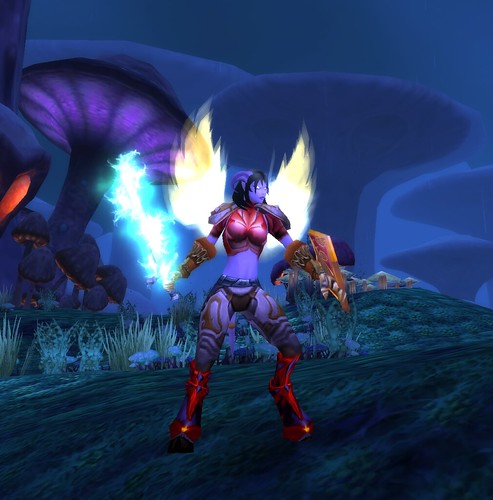
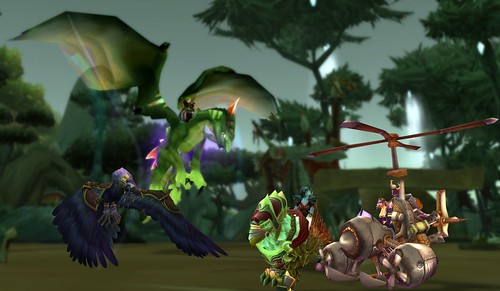
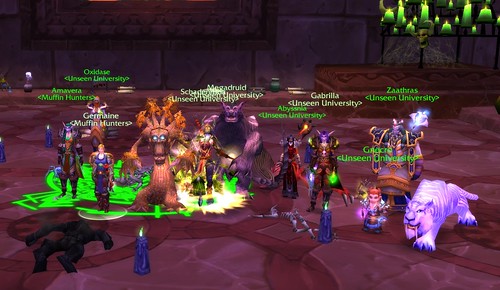
New character posing/3D model viewing tool from inside the Warcraft armory came out tonight. Wowhead has had something like this, but this one finally lets you scan through the animation loops, and has pretty high quality visuals to boot. I'm kind of surprised they didn't add Twitter & Facebook links though -- that seems de rigeur these days :)

My main:

My eeeeevil alt:

...and the somewhat camera-shy in-game standin for me:

November 16, 2009

Documentation & Dragons

One of the enduring fixtures of my time in Austin has been Saturday gaming. We've gone through a variety of systems in our time, including GURPS, a couple variations of D&D, and some pretty interesting indy systems (and some Mary Sue-tastic stretches of freestyle storytelling). Of late, we've been playing Dungeons & Dragons 4th Edition, and having a blast doing it.

D&D4e has streamlined a lot of the combat from previous incarnations, and, dare I say it, made it actually fun. In earlier incarnations, I had special abilities, but I never particularly felt encouraged to use them. In 3rd Edition especially, I felt I spent most of my time doing auto-attacks. 4th edition almost falls over itself to throw a variety of powers at you, though, and most of them are one-time-use, so you're actually encouraged to mix up what you're doing. Because the combat is more fun (and also because good GM software tools are provided to ease the creation of encounters), we find we pull out the grid map way more often then we ever did before.

At some point when we were doing this, Kevin -- our GM -- started trying to take pictures of the board as we were going. He'd been inspired by the Penny Arcade d&d session twitters. I found this to also be pretty interesting, especially with the following combo platter of geek tools:

  • camera on iPhone
  • twitter & facebook apps on iPhone
  • decent photo editing tools on the iPhone (like my current favorite to abuse, TiltShiftGen)

I do have a blogging app on the iPhone, but it's way more annoying to use. So I thought I'd take the time and put together a longer entry on the phenomenon and output of this.

Beginnings

I started using the camera just to document stuff that I'd put on the tabletop whiteboard, in case it got erased before the next week. For example, here was an experimental system we used to track a particularly amoral character's swings to and from the dark side:

Systems experimentation, before we dug into D&D 4e.

I took the shot as a quick and dirty way to make sure I knew how the points were laid out between sessions. This actually predates GM Kevin's interest in the PA twitter feeds.

Here's another example, where I was tracking gold & XP for my character on the whiteboard (our GM has moved to tracking this stuff via a D&D oriented wiki space):

Record-keeping via pictures. Note the pattern spider!

The dapper gent with the multiple legs and the top hat is the famed "pattern spider," who likes from time to time to jump into our games and dump lots of exposition on us. (As I recall, the in-joke here is mostly making fun of me, for badgering Kevin in an early game to explain the whole mystery through this one NPC that had the grievous loophole of having an omniscient viewpoint. For some reason, the spider had a fancy hat and a cigar and a Brooklyn accent.)

Action shots

Our first fight with a dragon, after having proceeded through a dungeon.

Here we see my first effort. Note how masterfully I tank the dragon away from the group, putting all of my hard-won World of Warcraft experience to bear. (A few turns earlier I'd let the dragon turn and toast everyone >_< )

Later on, I picked up Camera Bag, which had handy pre-canned photo effects. I became a quick fan of the vignetting here:

...and after. This was our first serious dragon fight, and marked the transition to the Paragon tier.

At the end of the day, the iPhone camera is fine, but it's not going to shine in a room that's only lit by some normal light bulbs. So I'm kind of trying to embrace the grainy, cruddy nature of the cameraphone with this. Also, it's in Fantasy Past Time, and thus should be colored in the style of a Wild West Poster, which was pretty much the same timeframe.

Later on, GM Kevin picked up the aforementioned TiltShiftGen, and started FBing pictures that were clearly manipulated with it. A tilt shift lens (or software program used to fake the effect) provides a very distinctive dollhouse style, as you can see at the linked website.

I've only used it a bit, and I will freely confess that I actually am using it even more for the color sliders. But being able to fake a depth of field effect is pretty nice. The main problem I have with it is that it degrades pretty quickly at the cruddy resolutions & qualities that I'm capturing in this environment. But still, I was pretty happy with the ominous result obtained here:

The umber hulk lurks in the distance.

November 01, 2009

Demon's Souls

Several good games came out recently. There are plenty of people who will (correctly) tell you to pick up Torchlight, or Borderlands, both of which evoke the spirit of Diablo in different yet very awesome ways. I've also been finally trying out Halo: ODST and liking it very much. There's even a few new MMOs out -- Champions Online and Aion -- that are both beautifully flawed in their own special ways, and probably deserve a little blog action. But I'm not here today to talk about any of those fine games with you.

No, I'm here because I want to share about a game that wants to crush your soul.

So, I keep hearing about this game, "Demon's Souls." I keep hearing that it's hard, it's unforgiving, and then -- my favorite useless piece of information -- that "failure just means your strategy was wrong." Nobody actually described what any of this stuff means. So here's first impressions, if you're wondering about this game. Sneak preview: it's cruel, but captivating.

First off, this game does not want to be your friend. There are absolutely no story breadcrumbs in the first few hours that I've played. At some point, when the game wants to introduce you to a particular gameplay mechanic, it just puts a boss that will one-shot you in your way. "But Eric," you say. "OMG spoilers!" you say. To you I say, shut your damn pie hole, this information is not going to actually help you in any useful way.

Character creation is terrible -- you have lots of sliders, all of which affect other sliders in obscure ways, and all of which basically turn your character from Moon Boy into The Kid From Mask with the merest flick of your wrist. There is literally no setting of the face sliders that doesn't result in a deformed creature from beyond the widdershins dimension -- which, now that I think on it -- may just be another metaphysical statement the game is trying to impart.

The game prizes exploration. Almost nothing is explained. Any explanations you find are going to come from your fellow players. Because, in a way, this is the most lonely MMO you will ever, ever play. Did you die? Your bloodstain will show up in my game, and if I see it and click on it, I can watch you vainly fighting against an unseen foe, and perhaps gain insight from it. You can leave me messages. The messages are from a heavily templated menu-driven system, so your messages will actually all be grammatically correct, and filled with thees and thous, but if your message is helpful, I can send you a heal. Sometimes your ghostly form will appear on my screen, going about ghostly and mysterious tasks.

So when we play, we play in the same world, and we see each other -- but only in dim echoes that remind us purely of the futility of our own struggle against the demons. Also, there's no /trade chat, and that's pretty cool.

The game kind of starts when you're dead. Dying causes you to leave a bloodstain on the floor and restart life as a ghost -- a ghost that can basically do everything your living self can do, but just has half the health to do it in. At this point, the game will remind you of when you played Rainbow Six, because you'll have to venture through this dungeon to kill the big bad at the end. And on your way you will die... a lot. And when you respawn, you'll re-fight through the same dungeon with the same enemies doing the same things. So when people talk crap about how "dying means your strategy was just wrong," they basically mean "dying means you didn't remember that the one guy with the flaming eyeballs jumps out from behind the wall when you get to step 413, and you didn't counter with the witty repartee maneuver... GOD."

Should you manage to win your way back to your bloodstain though, well, good news: you can get the XP back that you left in a puddle on the floor.

So, nothing is explained. The manual is useless. Mana doesn't even regenerate unless you start out as a coddled Royal, who's looted the royal treasury for some nice gear. Progress is a combination of exploration, experimentation, and memorization. At any moment you could be set back to where you started and have to replay 10-15 minutes of your ghostly life again. Why the hell would you even play this game?

What can I say? The combat is BADASS. Blocking, riposting, parrying, combo moves, some magic thrown into the mix -- it's exactly the kind of fake-fantasy combat RPG model I've always wanted. The inner loop of this game is more fun than the cruel outer loop, and that's what drives me on.

Also, I think about that poor ghost still wandering around that castle and I feel bad -- maybe this time I can win through and re-unite my avatar with her mortal coil. Maybe. I'll probably just get pissed again though and play something else.

October 27, 2008

For two weeks, anyway, I've beaten the World of Warcraft

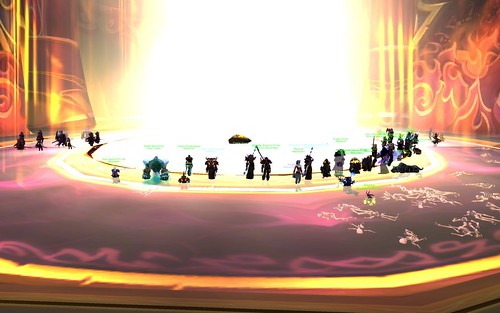
The final boss of the final dungeon in WoW emerges:

and then is cast down as we rekindle the Sunwell:

The 3.0 patch definitely made Sunwell a lot more beatable, but Kil'Jaeden was still a pretty hard fight -- it felt very satisfying to beat. I'm feeling a bit of a rush right now. It's also nice we were the first Alliance guild on Spinebreaker to achieve this feat. It was kind of fun knowing the other ally guild that had been ahead of us all this time was racing to do the same alongside us :).

As a side note, I also finally got this cool rare fiery horse from the first boss in Karazhan yesterday:

Virtual life is good.

September 23, 2008

Addendum re: Rock Band

Addendum to my previous post:

I also want to point out that Rock Band gets this -- but Guitar Hero does not. RB makes it super easy to use all of your downloaded content ("stuff") with RB2. It also works with pretty much any instrument controller. GH doesn't work with RB controllers -- on purpose -- and the GH: Aerosmith expansion didn't work with any GH3 downloadable content. Also, RB2 very cleverly made it easy to re-create your RB1 characters, although if they'd really been on top of it they would have included character import from RB1. Guitar Hero 4: World Tour wants very hard to win on features alone, and I will admit it's a compelling list of features. But... I already have the RB1 instruments, and the RB1 songs, and a bunch of songs I bought. I don't think the slidey touchpad frets are going to be enough to justify having to buy all new stuff. Did I mention I also hate to move?

MMO as OS

There are interesting comparisons to be drawn between online gaming platforms and operating systems. I'm going to define OGPs fairly vaguely -- Warcraft is one, so is XBox Live, so is Steam -- in that they allow you to play games with other people, provide community features (messaging, achievement comparison), and give you some kind of game to actually play.

These OGPs represent a kind of "stickiness" that keeps you coming back to the game or games supported by those platforms. If given the choice between a game that's out for PS3 or XBox 360, I'll buy the Xbox game even though I own both platforms. Why? I can see my Live buddies if I'm playing the XBox game. You end up investing in your online experience. In Warcraft, I've spent a lot of time developing my library of applications (characters, addons), and I have a lot of interest in maintaining interoperability with others (the social groups I've developed to play games with).

There's even now a Bejeweled that runs inside of Warcraft. The next major upgrade will include in-game calendaring on top of the pre-existing mail system. The todo list -- quests, if you will -- is also getting a major beefing up in the form of new achievements, XBox Live-style. I've long contended that Warcraft is the most interesting online productivity suite out there, if you're willing to accept that killing giant dragons is an interesting group productivity activity.

And why not, really? So much of our 21st century life is based around the production of things that have no physical basis. Yes, the software I develop gets dumped onto a CD or DVD every so often, but that's an artifact of distribution -- and since I don't work on distribution, there's nothing tangible, really, that I craft with my fingers. (And iPhone apps are purely virtual!) What remains interesting is not the physical or virtual mementoes of the process, but the act of doing, and the social constructions that remain from that act. In this, online gaming now resembles blogging, in that the community and the memetic constructions are what remain lasting.

So what's a new game to do in this space? One could liken the release of Warcraft to the release of Windows 95 -- a social gaming space that finally broke through to the masses. (I'd say the same for Live and Steam but really... nothing like them existed before for the markets they address.) Before Warcraft, MMOs existed -- the DOS of DikuMUDs, the Windows 3.1 of Everquest -- but they had not yet shattered that accessibility and usability barrier to really catch on. And since Warcraft, there have been a number of attempts to learn from and inherit the space that Warcraft owns, but none have really been successful. I've tried several of them -- some, like Lord of the Rings Online and the most recent, Warhammer Online, are fairly faithful extend & embrace copies of Warcraft. So why do they not have the same traction?

It's that stickiness. When Age of Conan came out, the die hard neophiles jumped to it -- in the millions. Funcom's stock price rocketed. But then those same players abandoned the game in droves. Why? The social space wasn't as rich. The game itself wasn't as mature and stable. And, frankly, you didn't have your stuff. Why don't people jump from one OS to another purely based on features? The reason I hear most often is, "I'd have to re-buy (or re-acquire) all of my applications." Switching online gaming platforms is getting to the same place -- you want to play the one your friends play. You want to play the one where your stuff is.

I've been messing around some with Warhammer Online (and did the same with Lord of the Rings Online). Both games clearly very carefully learned the UI lessons of Warcraft. Jumping into both games feels very comfortable for an experienced player, and they've clearly taken care to make the experience pleasant for the new player as well. But neither stuck with me because I have great affection for my communities and my little avatars.

What's the solution for these brave new upstarts then? To be honest, I'm surprised nobody's done it yet. It's the same as the solution for, say, a plucky presentation software upstart that's challenging the dominant paradigm. You provide the ability to work with your old stuff, and another compelling new features to make you feel like you're mistreating your old stuff to work with the old app. Blizzard's already put the foot in the door already -- all of your WoW characters can be examined (in XML format, no less!) via the armory.

Mark my words -- some brave asshole will finally put two and two together and make a WoW character importer for their new game. And it'll work terribly. And their will be lawsuits. But then the idea will be out there. And then, eventually, we'll see avatar portability and a persistent, interoperable virtual stuff space. I give it ten years. After all, somebody you know is probably raiding tonight. These virtual spaces are here to stay.

September 03, 2008

Sisters

Sisters of the Light

Somehow, in my characters' elaborate backstories, they all end up to be family members. Here, we see Cynnosure, holy warrior, posing with her younger sister Checkers, who has recently embraced the light. These two holy warriors are nothing if not pragmatic -- Cynnosure saw Checkers' time spent studying the shadow as only sensible.

Sisters: Neutral Territory

Cynnthia & Felicia have a somewhat more complicated relationship, as they had very different reactions to the death of their parents to the Scourge. Cynnthia chose to confront her anger head on, with a sword. Felicia has adopted the dark magics that brought the undead into existence -- she says, to better combat them. Neither really understands or respects the other's decision, but they still try to make it work.

Sisters: Reunion

Cynndethiel Stormwalker had a sister, once. Dechesel was lost in the fighting when the Burning Legion invaded Ashenvale, and was presumed dead.

Imagine, then, Cynne's surprise when the Knights of the Ebon Hold renounced the Scourge - and Dechs was among the undead Death Knights now returning to the Alliance, and renewing old ties.

August 08, 2008

Cynne Stormwalker


Cynne Stormwalker, originally uploaded by tiltology.

I'm aware that my occasional hobby of making MMO character portraits is just one of the many ways in which I am a huge dork. This, however, is extra dorky because it's formatted for use as my iPhone background. OH THE BURNING.

June 17, 2008

Mass Effect for PC

I've been replaying Mass Effect on the PC; I'm almost caught up to my XBox 360 save.

Misc notes:

* It's amazing how I'm pretty much playing the game in the same order. I wasn't even able to successfully make a different looking character. I'm not sure what that means. I'll probably try it again later as a Renegade, though -- hopefully that'll help me mix it up some.
* I had vowed to not to do the side-quest planet missions; this is a vow I did not keep. Now that I'm almost up to where I was, though, I'm remembering *why* I made the vow. I'd thought it was because I found the travel & quest log system irritating. These turns out to be minor inconveniences. What wears on you is yet another planet where you have to listen to your buggy go "wrrrrrrr" while you try to get over this really large mountain that your FREAKING SPACESHIP could have dropped you on THE OTHER SIDE OF.
* And then, once you get over the mountain, you get to either see the Cave Dungeon, the Installation Dungeon, or the Spaceship Dungeon. Seriously, guys -- 5-6 more stock dungeons for your side quests wouldn't have killed you.

On the plus side, the PC combat is more fun than the XBox combat, if for no other reason then you can hotkey abilities and not be pausing all the time. Also, the load times are way better, and I'm not in constant fear that the XBox will decide to stop reading my disc and effectively lose my progress.

I need to remember to make a sniper/tech class next time though.

I'm definitely digging it as much the second time through, though -- I think I might actually finish it this time.

April 28, 2008

Interactive Fiction Miscellania

Three links, in order of length (from longest to shortest, so if you're feeling ADD click on the bottom link first, and work up).

This is from a few years ago, but it's been getting reblogged a lot recently: Let's Tell a Story Together (A History of Interactive Fiction). It's an engaging read, and includes some recommendations of modern IF works to check out. I bought the Infocom Masterpieces collection back in the day, though -- it may be time to bust that out again and enjoy some old friends.

Also reblogged from a few different sources: Milliways: Infocom's Unreleased Sequel to Hitchhiker's Guide to the Galaxy. This guy has a copy of Infocom's shared drive from 1989, and does some archeology on it to find out some of what happened to HH2. And then -- a bunch of Infocommies descend in the comments section to reminisce and correct. It's fascinating. The comments have the usual amount of Internet e-thuggery, but they're still worth skimming over for the Infocomments.

Finally, an interesting read on the process of delivering a hotfix for an MMO.

The 360 has re-entered the building...

...and the 20 minutes of Rock Band we tried before bed last night were pretty awesome. The hour of unpacking and setting up Rock Band -- less awesome. But hey, that part is done now!

April 17, 2008

Mass Effect, revisited

Marty requested that I revisit my Mass Effect post. Sadly, I must reveal that my XBox 360 was stolen back in January, and I have not yet gotten around to replacing it. We were watching TV one night, and I looked down, and the 360 and the PS3 were just... not there. To which my only response was, "hey, didn't I used to have a 360?"

I'll probably be replacing the 360 soon (one of my brothers is moving to Austin, and we have plans to found a Rock Band, if you know what I mean), but my jumping back into Mass Effect will almost certainly be dependent on the PC version being released. Still, I can comment on what more of the game I played between my last post, and the disappearance of my save game. (Oddly enough, that's what I was most upset about -- they stole my save game!)

Bioware has this structure to their games. There's

* the initial story hub area, which you must complete before you can unlock the "freeform" part
* the "freeform" part, which typically consists of three less-well fleshed out sections than the part that initially sucked you in
* a bizarre final sequence that you can identify because they've taken away your ship.

I am always a sucker for the first part. It's where they do their best work.

In Mass Effect, they tried to spice up the relatively thin pickings in the freeform part by adding some collection games. Being full of OCD, this initially satisfied me. Then I got irritated by the lack of in-game interface for keeping track of the collection games. I was keeping a pen & paper list of which systems I'd explored so far, and it was driving me nuts. When I revisit the game, I will probably skip most of the optional stuff, and just dig through the story.

That being said, I was still digging on the combat, the writing, and the visual look of the universe at the point I stopped playing. I just stopped enjoying the filler where I drive my ATV around the restricted subset of the planet to find the macguffins.

Marty also mentions the whole good vs evil problem. I didn't mess with the "bad" choices much in the game, but I guess I had more of an impression that -- like in Jade Empire -- that evil wasn't evil so much, as a philosophy of, let's say, personally-oriented goals. The good/evil stuff is just a way to hang unique snowflakes on the infinite hallway, however. The story isn't fundamentally going to change. Sure, the final cutscene may vary (see Bioshock), but it's a narrative trick to give you the feeling of agency in a story that cannot possibly be customized for you.

February 14, 2008

Notional Postcards from an Imaginary Land

I'm not sure what compels me make these postcards from an apocalyptic alternate land of struggle and magic, but make them I must. All for you, the home viewer. I imagine Cynne traveling on her many journeys, and thinking -- say, I bet the folks would really enjoy the scenery that underscores our impending struggle between good and evil.

She's more considerate than I am, in many ways. Odd and crazy... but true.

December 09, 2007

Warrior of the Light


Warrior of the Light, originally uploaded by tiltology.

Like Gandalf, my Paladin is an angel.

November 22, 2007

Mass Effect Initial Impressions

The long awaited Mass Effect came out this week. It's BioWare's second take after Jade Empire at doing their own IP and... they did a pretty darn nice job.

If you've played other BioWare games, the biggest shift here (as in all of their games) is the combat system, which is always the place where a heavily story & converstaion based RPG can fall down. So let's talk about it first. The combat here is a little impenetrable at first. They borrow from squad-based FPS games this time instead of from the Virtua Fighter class of games. You shoot at people, and can issue orders to your squad, and it seems OK until all of a sudden some dude takes out one of your guys instantly and you don't really understand why. It took me a little bit to get that I did actually want to use cover -- and have my squad use cover -- and the game waited a little too long to explain that I could pause the game with one of the shoulder pads and assign special commands to each person. Once I figured out I could overkill somebody with three special moves at once, combat got a little more interesting.

That being said, in three hours of gameplay, only 30-40 minutes of it has been combat so far, so I also don't really feel like I've gotten a chance to practice the combat much. I kind of expect that to change once I get past the inevitable "that first well developed planet BioWare does before they give you a ship" model. The manual sort of leads me to believe that rather than the normal KOTOR one planet -> three or four planets -> finale planet model, I'm going to be able to explore tons of random planets ala Wind Waker or Oblivion, and get completely sidetracked on alternate missions if I don't follow the main story mission. We'll see.

Next up: presentation. Wow. OK, blah blah, 360 graphics are pretty. But more importantly, the visual design of the game is just incredible. That part of me that wants to nerd out in a cross-breed universe of Star Trek and Star Wars, without having to get bogged down in the decades of continuity and staleness of either, is totally digging this new space BioWare has dreamed up for me. The ship design, the alien design, the enormous space stations, the backstory -- I'm just loving all of it so far.

The conversation system is the real revelation, and it's not because it's new in any way -- it's because they've done some important refinements on what they've been doing all along.

  1. Excellent voice acting, including the main character. This, combined with subtitles off (by default) and good camera placement during the conversations, means that I actually want to not skip the voice stuff.
  2. Queued responses. Your next option shows up while the previous response is still playing out, so you can keep the conversation flowing. I'm not skipping the last phrase just so I can get to the next choice.
  3. Response text is not the same as actual voice response. The response text reflects your character's state of mind more than in previous BioWare games. This is harder to quantify, and might drive some people more nuts, but you basically get a short phrase to choose from that actually turns into a longer phrase that's more... in character? Whatever it is, it works.
  4. Physical placement of phrases. Phrases on the left of the wheel extend the conversation and delve into the tree; phrases on the right bring the conversation to conclusion. Phrases at the top are more selfless; phrases at the bottom are more selfish. This additional feedback can help decoding what a phrase's gameplay impact might be be keeping placement consistent. It's subtle, but effective.

No spoilers in this example. There was a quest/conversation I recently hit that -- well, a man was asking after his wife. He needed some help in talking to another person about this. When talking to both parties, I was given my "charm" option, and in both cases, I could use it for something that seemed like a good and right thing to do -- but the right thing to do totally depended on what my character actually thought was the greater good. So I ended up convincing one of these two that the other was right -- and I actually teared up a little. Yes, in some small subtle way, BioWare finally nailed the essence of small-scale emotional storytelling. I'm not saying the whole game is a masterpiece of storytelling, but you can tell they've been doing this for a while and they're pretty good at it.

The game's not perfect. Combat and character leveling are still somewhat opaque to me. Targeting is a little twitchy. The minimap seems to be kind of useless. But I really like what I've seen so far, and I'm eager to see what the game is like once it opens up and I'm not just exploring a space station, huge and well developed as that space station might be.

November 21, 2007

Virtual Bling

Here, by the way, is what I needed a working copy of Photoshop for:

A Collection of Flying Mounts

My various alts don't really have a chance to hang out together much, you see.

November 10, 2007

Nerd Gaming Multimedia

Carrie & I, of late, have been spending our Thursday and Friday evenings running what is known as "a raid." Yes, we break open a bottle of wine, order a pizza, and settle in with eight buddies that we've mostly never seen before. And then, we venture into the mysterious tower of Karazhan, in World of Warcraft.

"Kara," as the kids call it, is the centerpiece of this most recent WoW expansion. It's not the toughest thing going, by any means, but it's the first raiding-quality dungeon that Blizzard aimed at smaller guilds. Originally, the game had stuff to do with five people... or stuff to do with forty people. There wasn't a lot of middle ground. So, when at some point you realized you'd exceeded the challenge of the five person stuff, you had to make a huge organizational jump in order continue advancing your character and gets the shiny loots.

There were a few dungeons aimed at 10-15 people, but to really find the interesting boss fights and newer, better rewards, it was 40 or the highway. And forty folks makes it kind of inevitable that the discourse level is going to sink down to the daring wit of "your mom!"

Karazhan fixed a lot of this for smaller guild. We're a pretty active guild, but we also have folks with diverse interests and skill levels, not to mention scheduling conflicts. So, a really big dungeon aimed at ten skilled players? Gravy, baby.

When we started on this endeavor in May, we had interest, but we were kind of lacking in gear and experience. So... we spent a month or two hitting our heads against the first few bosses, feeling frustrated, wondering when the tide would turn. And, little by little, it did. Carrie grokked the roster organizing issues needed to ensure we'd have a good shot against various parts of the dungeon. I fussed with our lineup and folks roles until our tanking and healing were a nice strong base to support our damage-dealers with. We learned strategies. We educated folks on gameplay. And....

Well, this week, I took a couple of movies to demonstrate our progress.

First off, Moroes, the second boss in the dungeon (and the first one you can't skip).
Moroes has four guys helping him. You have to deal with those four guys somehow, by controlling them or killing them, before you can work on the actual boss. Normally we deal with this by bringing plenty of crowd control, and dragging these other guys out of the way. But we've been noticing our main tank is pretty tough lately -- so this is us using raw brute force to blow out this fight:

Sorry, my camera's pulled back pretty far in that one -- first try at this sort of thing.

Second is the guy who lives at the top of the dungeon. We killed him the first time last week. This week, Chris & I both shot video of the fight, and I messed around with the new iMovie to mix it together:

So, if you find yourself wondering what the heck I do in my leisure time... now you know.

November 04, 2007

Random Game Notes

Hellgate London does a surprisingly good job of making the different classes play very differently. Even though it's an MMO, the shooter classes actually feel FPSy. That being said, despite the fact it was developed by some of the guys who developed Diablo -- it's no Diablo. The random environs of the subway tubes are ultimately pretty sterile, especially coming off of a Portal kind of a thing. I also object to having to click 10-12 times on the quest giver to get all of the flavor text -- would it kill you to just give a quick summary and then dump the color text afterward for nerds like me who want to read it in one blow? Or give me some quests that force me to use parts of your game system so I know what they are? You can tell by all the small experience details these guys got wrong that the folks who stayed at Blizzard are the guys who make that company what it is.

Speaking of Portal, I can't believe I never spoke of Portal. It's freaking awesome. Best 2-3 hours of your gaming life. A perfectly designed and balanced little gem. Go play it.

Half Life 2: Episode 2 was a lot of fun, but it was no Portal.

Finally finished Halo 3 last night after a couple weeks of being too irritated with the "rescue Cortana from zombieland" level to get back into it. It was, in the end, Halo -- only three-ier. What can you say? They know how to make that game, and they did it well. My system totally failed to red-ring too, guaranteeing me some deep frustration when Mass Effect finally comes out.

Sam & Max: Episode 1 totally captured the flavor of the original Lucasarts game, and I can't believe I've gone this long without playing these things. I will grant you that these are adventure games, with all of the stupid inventory puzzles and tedious dialogue trees the genre implies. However, the important difference here is that you mostly care about hearing the comedically genius non-sequitorial dialogue, so it's all OK.

In WoW news, we downed two more of the bosses in the dungeon, leaving us one to go:

Illhoof Dead

Prince Dead

(I'm the big tree.)

I'm just incredibly proud of our group -- they've come a long way, they play smart and hard, and they keep bring their A game every week. It's been a really positive experience for Carrie & I to lead this group every week, and watch our team develop over time. Looking forward to downing some trolls in this upcoming patch.

Note to self after re-reading this entire list -- go play Psychonauts you cheap bastard.

October 01, 2007

Halo 3 and BioShock

I told myself I wouldn't buy Halo 3 until I finished BioShock, which was a good bullshit deal to make with myself, as I have now finished off the latter, fine game. I've been a fan of the works of Looking Glass Studios and Irrational Games since way back. I didn't actually play the original System Shock, but I played Thief and System Shock 2 and loved both games' approach to toolkit-oriented, exploratory gameplay. The fact that BioShock carries on this tradition with the added bonus of -- for once -- contemporary quality graphical effects just was extra icing.

I'll quickly get out of the way my gripes and raves. Gripes? BioShock is only a mediocre shooter. It controls a little funny. The respawn behavior is just as irritating here as it was in System Shock 2. The Vita Chambers are a nice concept, but they do suck some of the tension out of the game. Raves: incredible art direction. An emotionally satisfying conclusion. Lots of little rewards for poking around all the places you can imagine to poke around in. I was continually surprised at how Irrational made each level new and interesting, when it could have so easily slipped into the Doom 3 trap of "wow -- it's freaking dark." There's nice little touches, like a sequence where you get to try out all the different powers that you may have not yet used in the game up to that point -- and the sequence where you gear up to face the final bad guy, which is particularly poignant.

What was striking to me, however, was going from BioShock to Halo 3. I think they may, in fact, be opposites in nearly every way possible.

Halo 3 is all about big spaces. BioShock is all about confined ones.

Halo 3 is all about free flowing combat with lots of allies. BioShock is all about considered engagements where you make the environment work for you.

Halo 3 is big spaceships blowing up. BioShock is big cities imploding.

Halo 3 is about being a big guy in an armored suit rescuing a female companion. BioShock is about blowing up the guys in big armored suits who are protecting female companions.

Halo 3 echoes the story of Halo 2 and Marathon. BioShock echoes the story of System Shock 2 and Ultima Underworld. Oh, wait.

I love both games. They scratch totally different itches. Going from BioShock to Halo 3 was kind of like bursting out from underwater and feeling like I was back in the open air. Plot? Art? I dunno about that, son, but there's a big ass tank over there that could use some blowing up. And I'm just the guy to do it.

In conclusion, the divergent opinions of two respected friends (although both tend to agree on the base points, but reaching different conclusions):


  • psu on Halo 3: "There is really only one thing you need to know about Halo 3 and it is this: Halo 3 is Halo just bigger."
  • Nelson on Halo 3 and BioShock: "The Halo story is clumsy and poorly told, the visual settings are beautiful but lack poignancy, the music is meh. Halo is a very well crafted piece of gameplay, though, and I respect that part of the gamemakers art."

September 01, 2007

Zero Punctuation

Zen of Design points us at Zero Punctuation, the only useful thing Escapist has ever associated themselves with. Go check it out.

August 22, 2007

third in a trilogy

Kotaku continues to demonstrate they have no cognitive ability whatsoever in the conclusion to widescreen-gate.


So, yeah. I'll paraphrase the game developer's response: yeah we designed to the widescreen experience, and set up all of our assets with that in mind. But we had to deal with 4:3, right? So we had two choices -- letterbox, or just render the top & bottom portions you wouldn't otherwise see. We decided not to screw with the field of view, because you know what? The screen would look funny and pinched if we did that. We decided not to design to the 4:3 screen and then just add extra crap to the left and right because then you'd... feel like you were in a fishbowl.

I mean, guys, guys? You did notice that those TVs are different shapes, right?

My favorite response in the comments from the above link:

"The arm in the comparison screenshot keeps going in the 4:3 version. This would only make sense of the widescreen was cropped down from the full image."

Seriously, wow. That's brilliant, man. The man really stuck it to you by continuing to render the rest of the arm model so that it wouldn't look COMPLETELY STUPID in 4:3.

I hate people. Just wait until I release "I hate people episodes 1-3 -- a prequilogy."

For what it's worth, the claustrophobic feel of wandering around BioShock on a 16:9 screen is pitch-perfect. It's like some game designers, like, designed it.

Decline and Fall

If forum posters really behaved that way in real life: Internet Commenter Business Meeting (audio contains swearing and is probably NSFW without a headset).

(from kill ten rats)

In other news, I played BioShock some last night. I really like what I've seen so far. The introductory sequence is beautiful -- put me right back onto that tram in Half-Life, but even better. If you like System Shock 2, this will feel very familiar. I confess I was a little surprised they finally got away from their obscurely sophisticated leaning system though :).

August 21, 2007

The Stupidest Thing I've Heard All Day

So, get this. Apparently BioShock's widescreen support is "screwed up". Go ahead, click the link, look at the example.

Yeah, that's right. People are pissed off because the camera they control is showing a view that's wider than it is tall on their widescreen TVs. Let's stay focused on that core issue -- the camera that THEY CONTROL.

Seriously, reading the comments is like bad comedy. This isn't a freaking movie where shots are all carefully framed. This is an FPS. If you play an FPS on a widescreen TV? The top and bottom aren't there. The viewport is a different shape. Maybe you noticed this when you bought the TV.

May 01, 2007

Fallout 3: Rose-Colored Post-Apocalyptic Glasses

There's footage of the tech demo of the coulda-been Fallout 3 as Black Isle would have done it. Black Isle, of course, was the Interplay RPG division responsible for Fallout, and Fallout 2, which were both brilliant games. It was also responsible for Fallout Tactics: Brotherhood of Steel, which was... not a brilliant game.

But then Interplay lost their way, and the next game in the Fallout franchise was one of those crappy "RPG-lite" console games, that pretty much missed the whole point of turn-based tactics and well-written cynical humor. And then Interplay/Black Isle pretty much self destructed. And we all figured that was that.

BUT WAIT! We come to find out that Bethesda Softworks, who was responsible for the equally -- if differently -- brilliant Daggerfall, Morrowind, and Oblivion have acquired the Fallout license. Which has caused a great wailing and gnashing of teeth among the "Fallout faithful," about how THIS WILL RUIN EVERYTHING. But for the Fallout fanboys out there, especially those posting about how watching this video brought a "tear to their eyes," let's be clear: this video demonstrated that Black Isle's vision for Fallout 3 was to do EXACTLY THE SAME THING OVER AGAIN, but this time with crappy 3D models instead of 2D models.

Ahem. Sorry about the caps, there. Talking about fanboys brings out the mouthbreather in me, too. But this video clearly demonstrated to me that there was nothing we were missing from yet another Black Isle run at this. In fact, having played Neverwinter Nights 2 from Obsidian, the guys who -- if they'd kept their jobs at Interplay -- would have been doing Fallout 3, makes it abundantly clear that the turn-based CRPG is currently in the hands of a fascistic and dogmatic Cromwellian regime who are so tearfully holding on to the past that they have no vision for the future. So thank all the powers that be, I say, that Fallout 3 is not going to sully the memory of a great game, and that Bethsoft will have the guts to take the franchise somewhere different, even if that somewhere different sucks.

December 02, 2006

SketchFighter 4000 Alpha

SketchFighter 4000 Alpha is a side-scrolling shooter of the finest old-school trapper keeper stylings. If you've got a Mac, try out the demo! (Found on Joystiq, where the "Mac-only" note naturally caused the stupidest of flame wars in the comments.)

November 28, 2006

Asteroid's Revenge

Asteroid's Revenge (found on del.icio.us). Flash game genious: You're an asteroid, and you're trying to blow up ships.

November 23, 2006

Shiny, Gritty Worlds

As we have the week off, I have been taking the opportunity to finish off some of the games I have bought recently.

Dark Messiah of Might Magic

Dark Messiah is branded as a Might & Magic game, but this doesn't really mean much more than "it's a fantasy FPS." And that's fine with me. In face, my experiences with the last several M&M RPGs were so irritating that I assumed this game was also going to be a waste of my time, until I downloaded the demo. Go ahead. Go download the demo. I'll wait for you.

People have had mixed reactions to this game, but I'll say this -- if you loved the demo, you'll love the game. Because the demo showcases why this game is incredible: a visually amazing fantasy world in which you get to burninate, stab, freeze, and kick people -- the latter preferably leading to any of the former, unless by happy accident your foe has his back to the abyss. Yes, yes, the story is trite and predictable. But we're not here for the story. We're here because Dark Messiah absolutely nails sword & sorcery combat in a first person setting, and dresses it up with Half Life 2-quality visuals. The game has a limited RPG aspect -- think Deus Ex. As you proceed, you can tweak your character along the brute warrior, archer, assassin, or spellcaster paths, or any combination of same which works for you. Combat is great -- while you can just whittle down an opponent's health, you can also create opportunities to end the fight decisively in your favor. Foe knocked to the ground? Execute a coup de grace. Worked him around to merrily blazing open fire? Kick that sucker in. Or use your spells to freeze him, lure him into a trap, or just charm him into working for you. Stealth kills also just... feel right. And the rope bow from Thief makes an appearance (as does another homage to that great series -- a master thief's outfit embroidered with a G, found in a room that to me looked suspiciously like a certain character's homebase in Thief 3).

The visuals will tax your machine, but they sure are purty. With Valve's high dynamic range support turned on, the contrast in light and shadows as you roam through murky subterranean tunnels approaches a virtuoso quality. Your fancy graphics card's fancy shaders will work overtime to put glossy sheens and gritty surfaces on everything you pass. Put it this way -- forget Oblivion.

In fact, "forget Oblivion" in general characterized my feelings about this game. I spent a lot of time traveling Tamriel, and enjoyed it, but it's a very shallow traversal of a lot of land. Here, the skills to choose from are extremely tightly focused, and -- since it's an FPS, not an RPG -- everything takes place along a highly designed infinite corridor. You won't be wandering the land looking for quests. You'll never vendor things to a merchant (no, seriously, you won't, so don't be a dumbass like me and hold on to every weapon you find). You will travel from Startington to Endville in a direct line, burninate all foes that stand in your way.

The game isn't perfect by any stretch, but it should be of no surprise to my regular readers that I am a sucker for the flawed gem. As mentioned, the story can be seen coming a mile away. "What, character M is EVIL? SURELY YOU JEST." They call the final boss sequence the "epilogue." Poison will keep ticking until your health hits 5 no matter how much you heal yourself. You can really screw yourself in the midgame if you haven't focused on a particular specialty -- I tried to straddle magic and combat, and wasn't good enough at either once I hit spiderville, so I burned through a lot of potions until I could fix that.

Gears of War

So, there I was, already impressed by the visual splendor of Dark Messiah. I kept hearing good things about this other game, Gears of War, but I'm thinking "yeah, yeah, the 360 has been OK and all, but I'll believe it can outdo my badass PC when I see it."

Yeah, well, now I've seen it.

Gears of War succeeds from a gameplay perspective, from a visual perspective, and -- to the extent it needs to -- a storytelling perspective. We'll deal with those in reverse order. The story is mostly straight Hollywood blockbuster schlock, including at least one mid-game revelation that's straight out of cheeseball comicbooktown. But that's ok, because the characters have just enough personality to -- as XPlay comments -- be interesting without being caricatures (loosely quoted). The banter between your squadmates provides just enough glue to keep you moving forward as you are catapulted from brilliant combat sequence to brilliant combat sequence in the midst of dilapidated visual glory.

The visuals truly are impressive. I do share psu's concern about the muted color palette, but the shiny! The gritty! The pockmarked detail on your Gears and on the environment add just enough immersiveness to really wrap the whole package together. More importantly, blur is used without feeling like a gimmick. When you spin the camera fast, or when you focus in on something, depth of field is actually used to effectively align attention, rather than to show off that they can do it. The coolest bit is the way that the camera foreshortens as you change what you're doing. The field of view actually changes cinematically as you pop in and out of cover, or barrel into a roadie run. It's subtle, but it's effective. Finally, whenever there's something you really should see, you can jab the Y button and your camera swivels to the current point of interest. It's just well done.

But that's all sideshow. We're here for the inner loop. And the inner loop is glorious. Other games have attempted to make seeking cover an essential part of gameplay, but Gears of War really makes it feel integral and strategic. Taking a play from the "keep it simple but deep" playbook, the A button is your all-purpose context sensitive "get me into cover" button and it works great. Getting nailed? Push towards a block and jab A -- your guy will paste himself against that brick like nobody's business. In cover and need to move? Angle towards another piece of cover and jab X -- you'll do the appropriate cool SWAT turn or barrel roll or whatever. It feels a little funny at first, but it soon becomes second nature.

Once you're in cover, the game becomes strategic. Keep an eye on those opponents as they move forward -- lay down some covering fire! Pop over long enough to take a guy out, but don't stay out too long. Lob a grendade! Call in a satellite strike! You have a simple set of tools, but their use is rewarding. I've played the game a lot these last few days, because getting to the next firefight and then getting through it remains a pleasure that comes in delicious bite-size chunks. Plus, at any time you can call in a pal to join your single-player game and make it multi-player. I shanghaid psu into helping me out with about half of Act 3, and it was a blast.

November 03, 2006

Truly the end times are nigh

A non-ironic travel article in the New York Times for Second Life.

October 26, 2006

Dark Messiah of Might and Magic

Dark Messiah of Might and Magic (reviews) came out yesterday, and I spent a fair bit of last night playing the first part of it. My short take: best fantasy FPS ever.

Things I like include:

  • It's very pretty. They use the Half-Life 2 engine to excellent effect. Now that I have a card that can deal with it, I think high-dynamic range support really makes things look kickass.
  • The sword fighting just feels... right. So much more so than the swordfighting in Oblivion. Rather than just beating someone down until their health hits 0, you try to gain advantage -- knocking somebody down and then delivering a coup de grace is much more effective than outlasting their endurance. Also, your special moves use up fatigue, a fast to lose but fast to recharge statistic. When your fatigue gets low, the game lets you know -- you can hear your character's labored breathing!
  • ROPE BOW. My favorite item from the first two Thief games.
  • Like Deus Ex, the game contains a rudimentary but effective skill system. You can mix and match elements of sneakery, hack & slash, and magic. So far, I'm enjoying the ability to freeze someone, which takes them out of combat and then later knocks them down, exposing them for a finisher.
  • I just can't get over how much fun a rough & tumble sword brawl in the game is. You can KICK people. Over ledges. To the ground. Into various hazards strewn around the environment.

Probably the only con is that it's an FPS, so like all good things that aren't MMO crack, it'll come to an end, sooner rather than later. But that's a strength, too. Oblivion had a lot of stuff to explore, but in the end, it was a breadth first exploration of a shallow world. This game, by virtue of focusing on linear level design, really pulls off a deeper and more interesting gameplay, since you don't get lost in the min-maxing details.

I'm pretty intrigued to try the multiplayer, though.

Download the demo. If you like the demo, you'll like the game. It's well worth the time to take a look.

Update: I'm still enjoying the game, but I'm starting to encounter random crashes on level loads. This makes me sad. Hope there's a patch soon. Also, I find myself keeping stuff in my inventory even when I'm not using it, because I keep expecting to find a merchant. I don't think there's a merchant, so I'm not sure why they bother limiting my inventory slots.

September 29, 2006

There's hope for the PSP yet...

...because both Loco Roco and Lego Star Wars are incredibly cool and fun on it. What's the secret? Colorful, stylized, but high rez graphics, and addictive gameplay. These games really show what the PSP can do when it's not trying to be a little bitty PS2. Sorry, DS Lite, but the PSP gets to ride in the airplane bag next week.

(Yes, I'm aware Lego Star Wars is an example of a big console title that got ported to the PSP, but it still feels like it was meant for the PSP.)

September 25, 2006

The Temple of Ahn'Qiraj

Time for another infrequent bout of epeening, as I take a moment to crow about our virtual victories in the fictional (yet small-country-sized*) World of Warcraft.

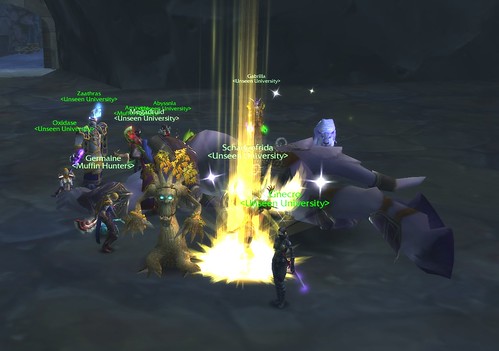
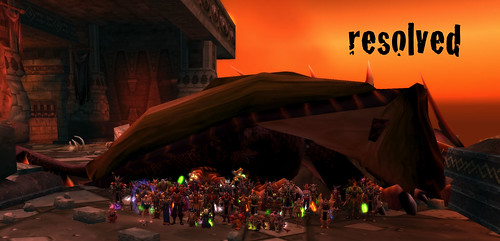
Resolve downs Nefarian

Resolve downs Nefarian

I participated in a rare Sunday raid last night, since our Friday night raid had left us this close to defeating Nefarian, brother of Onyxia, leader of the Black Dragonflight. No more will he and his sister manipulate the Alliance! Well, until tomorrow, when the instance resets and everyone gets on the ride again.

The "end game" 40-man content in WoW goes like this: Molten Core, Blackwing Lair, The Temple of Ahn'Qiraj, and Naxxramas. It's fair to say that the 40-man organizational requirement keeps most folks out of Molten Core, so even that part of the progression has a certain mystical awe to many WoW players. Nefarian is the end boss of Blackwing Lair, the second dungeon, and the first one to feature really interestingly designed boss fights that require a good deal of coordination and adaptability. We'd been stuck about halfway through the dungeon for several months, but in the past month and a half we got past our roadblock and have been making steady progress through the rest. This was our second serious try at Nefarian, and I'm proud to say we pulled it together and downed him after a handful of attempts.

This is a pretty big achievement -- yes, there are some pretty kickass hardcore guilds that are well into the most cutting edge of content, but completing the second major dungeon puts us in a pretty small class of folks. It was a pretty cool feeling, made all the sweeter by the discovery of a Stormrage Chestguard among the vile dragon's effects -- an armor upgrade I'd been extremely covetous of for my druid. (I'd already had the matching moose hat, so one more piece, and I'll be an extremely happy camper.)

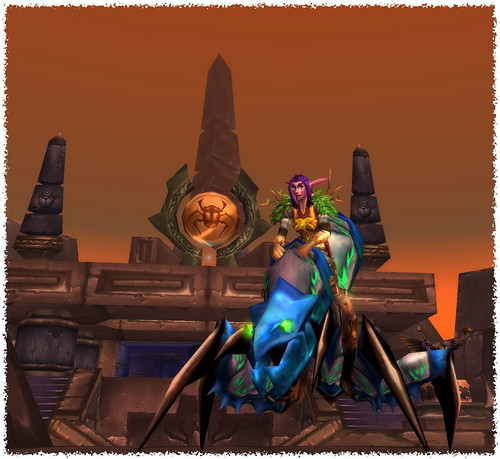
Bug mount from AQ40

Cynne, decked out in fancy new Stormrage armor and a bug mount

Since we downed Nefarian with some time left in our scheduled 3 hour raid, we decided to proceed to the Temple of Ahn'Qiraj, or "AQ40," as it is affectionately known amongst the "we hate to type things out" set. AQ40's mythology revolves around a mishmash of bug-monsters and Egyptian iconography (giant Anubis critters feature prominently). In the picture above, you see my druid about to descend into the mysterious temple of these creatures. But what, you say, is that mysterious mount she rides on? It turns out that -- once you enter the temple -- you can't ride your normal mount. (In Cynne's case, a giant blue panther. Just roll with it.) Maybe it can't take the confined spaces -- who knows. But, as you work your way towards the first boss, new bug mounts (which you can only use inside of AQ40, and which look nothing at all like Starship Troopers bug things) drop. I think they look pretty cool -- a Starcraft zergling you can ride around. I finally got mine last night.

So... yeah. I play because it's fun, and to see new stuff, and to see what we can do. But I won't pretend I don't enjoy nights full of delicious and delightful loot. Woot for loot!


* At 7 million active subscribers, the game currently ranks as being in the top 40 population centers of the world, and among the top 100 countries in 2006. That's freaky, man. Freaky.

September 22, 2006

The Inner Loop (and Outer Loop) of RPGs

So, in the throes of my Star Wars Hating, I wrote:

Starting and ending combat is irritating and distracting. Starting requires rebuffing your 20 second long buffs EVERY TIME. Ending requires finding the body to click on in order to loot. Why does a Jedi or Sith Master care about loot anyway? I think this game would have been better served leaving commerce out altogether. Maybe you get reputation (good or bad) for doing stuff, and can use that to improve your stuffs.

After some further IM ranting, psu took the opportunity to rant about loot in general. I found this comment particularly interesting, though:

Ugh, the surprise of finding something nifty in a chest or barrel is half the fun of playing RPGs for me. This has nothing to do with realism, it's just that I love the exploration aspects.

So, the question in my mind is -- why do I enjoy looting in WoW, but not in KOTOR2? In both cases, there's irritating inventory management, and random crap that mostly I can't use except to turn into money. Why not cut out the middleman and get right to the "gimme money" part?

I think that fundamentally, it comes down to the inner loop and the outer loop of the game mechanic. I'm going to say the inner loop is what psu calls the "30 seconds of fun." It's the repetitive mini-game that makes up the core of the experience. The outer loop is the meta-game -- it's how the inner loop's rewards are translated into long term character improvement.

The inner loop is the most important -- it is, essentially, the game. How much of your inner loop is spent doing the fun stuff? How is it distributed between buffs/combat/looting/resting for next fight? How hard is it to accomplish any of these stages? Am I clicking too many times per stage?

My objection to KOTOR2 was that the inner loop was a pain -- you had to click excessively to buff and loot. Depending on how you set up your character, downtime could be minimal -- but the healing to reduce downtime interfered with the buff portion of the next combat, because healing and buffing used the same shortcut key. Combat consisted of allowing the auto-attack to go off, or using one of several special abilities, all of which are really oriented around attacking guys who are weaker than you, because D20's combat system is kind of stupid. Looting was also irritating, because the loot didn't spawn until a few seconds after combat, and required clicking on a small portion of the screen (not necessarily the same place you had been clicking for combat), then clicking in some other portion of the screen to accept the loot.

Contrast this to WoW: most buffs remain around for 30 minutes, not 20 seconds. The grunt part of combat -- swinging your sword -- is automatic, leaving you to worry about strategic decisions about what combat abilities you will use. You might argue this is the same as the KOTOR case, except that the combat abilities here actually affect something more than your critical strike chance. Looting, to be fair, also requires finding a smaller area to click on -- the fallen corpse -- but you can shift-click to loot everything in one swoop. So, the high level details are the same, but the excessive clicks and mouse motion have been optimized out of the inner loop.

(Side note on buffs: there is one class in WoW -- the Paladin -- which has shorter term buffs. What's interesting, though, is that the casting of buffs is actual part of the combat phase, because you can "judge" these buffs onto enemies, turning your buffs into your enemy's debuffs. So, in this one case, the act of buffing is integral part of the combat cycle, as opposed to an irritating chore.)

So, what to do with that loot you get? Well, here's where we get into the outer loop -- what do you do with the spoils of the inner loop.

In KOTOR, the loot is irritating because there's (A) so goddamned much of it, and (B) you will -- with the exception of maybe 3 sequences -- NEVER EVER USE ANY OF IT. A lot of the loot is blasters and mines and grenades and... combat stuff that Jedi never use. And let's be clear -- the Jedi are so over-powered compared to any other class in this game, that unlike KOTOR1, it's actually possible to turn most if not all of your party members from blaster-wielding thugs INTO Jedi. So... most of the loot is pointless. On top of that, there's no cost to keeping all of that loot, because you have no inventory restrictions. So it starts to pile up. But surely, you say, you would sell it so you could get AWESOME GEAR from merchants! The problem is that there is no awesome gear from merchants -- it's more of this blaster/grenade/mine crap. There's the occasional Jedi robe, but nothing you won't see drop out of some... spider or bounty hunter.

So. No inventory restrictions. No reason to sell loot, because no reason to spend money. Why do I care so much, you ask -- it sounds like I just won't ever look at my inventory. Well, that's the problem right there. First off, I'm taking valuable time out of my inner loop to populate this inventory -- but I don't care about it. Secondly, every so often I do care about it -- some upgrade for my armor drops, or some miscellaneous item which I don't know much about, and might want to use. But, because inventory is chock-full of crap that I never bothered to sell, because -- for twelve hours straight -- there was no game mechanic that told me selling was a worthwhile endeavor to bother with, I've pack-ratted up 400 blasters because I might need one someday. And now I can't find the +10 shoulder pads of ninjosity, because it's hidden in a field of crap.

Obviously, yes, if I did my chores and was a good boy, this "wouldn't be a problem," but it turns out I'm playing this game to have fun, not to do my chores.

So again, let's contrast with WoW. What's interesting in WoW is that all that crap you'll never use? It's clearly highlighted as such. Items come in rarity classes -- grey, white, green, blue, purple -- and grey stuff is explicitly put in the game for you to turn into cash. No player will ever want it, but vendors will pay absurd amounts of money for it. White stuff is similar, except that player-craftable items might use it. Green and better drop infrequently, and we'll discuss them later.

So you've spent 30 minutes killing bugbears and your bags are getting full of grey and white stuff. Here's where another interesting part of the outer loop comes in -- similar monsters drop similar kinds of grey and white stuff, and the stuff stacks to some extent. So the outer loop is actually encouraging you to keep doing what you're doing, because you'll get more efficient use out of your bag space. It means that collecting crap for vendors is no long merely a grind as you populate your bags with mountains of miscellania -- you're actually playing a resource management metagame as you decide how to pursue various quests and still keep your bag space free.

But... what do you do with all that money? After all, in KOTOR2, it's pointless. In WoW, you actually need to acquire a certain amount of in-game cash just to keep playing. Armor wears down, and must be repaired. Fast travel costs money (although hoofing it is always free). Resources to improve your inner loop -- bigger bags, water & food to replenish health & mana -- cost money. Group content requires you to spend money on spell reagents and (for high-end content) protective potions. Once you've acquired some piece of gear you think you'll be using for a while, you might want to spend some bling to get it enchanted to make it even more badass. There's a sense of weight to currency that doesn't exist in KOTOR2.

On top of that, there's the fancy green and better items, which -- in some cases -- even if you can't use, someone else might be able to. So there's a whole economy mini-game based around selling this stuff to other players, either through negotiation or auctioning. Or that you might try to acquire for yourself, rather than spending hours hoping your magic boots might drop. Time spent is turned into money acquired; and money acquired can turn into time not spent. This is in stark contrast to a game where "getting through the levels" is the predominate design philosophy, so money and time are no longer fungible resources.


The short version, for the TLDR crowd: loot needs to not be intrusive in the inner loop (easy looting, stackable loot when you're engaged in the same task so that there's only a cost when you shift gears) and rewarding in the outer loop (money means something and contributes to your character advancement) in order to be a useful game mechanic. Otherwise -- it's just wanking.

September 16, 2006

Star Wars: Knights of the Old Republic 2 -- Followup

We've been re-watching the Star Wars movies lately, which inspired me to pick KOTOR2 back up and finish it. (Here's a link to my initial impressions.) I'd originally given up on the game about 10 hours in, because the promised lightsaber was nowhere in sight. It turned out I was still a good 2-3 hours away from the lightsaber, but I stuck it out.

Allow me to recant everything I said in my initial impressions. Upon further play, I found:

  • The plot was pure George Lucas: overcomplicated, unsatisfying, and chock full of pseudo-mysticism.
  • After taking a break from it, I have a renewed appreciation for Jade Empire's fighting style. The abstraction level on top of D20 really doesn't work very well, since there's no good feedback for enemy challenge ratings, and deciding what kind of attack to use is really just guesswork.
  • The game went from insanely hard to insanely easy once I got force speed (extra defense and attacks) and a lightsaber. While entertaining, that kind of disparity is not good game design.
  • Several of the subplots were inconsistent, or poorly fleshed out. There's like 4 or 5 ultimate badguys, and most of them I didn't really care about. You can only play the shadowy mysterious presence card so many times.
  • I will say I did like the twist on KOTOR1's "mysterious veteran of the war with no past" storyline. But still, the reveals on that storyline were too slowly paced.
  • Starting and ending combat is irritating and distracting. Starting requires rebuffing your 20 second long buffs EVERY TIME. Ending requires finding the body to click on in order to loot. Why does a Jedi or Sith Master care about loot anyway? I think this game would have been better served leaving commerce out altogether. Maybe you get reputation (good or bad) for doing stuff, and can use that to improve your stuffs.

So, yeah. It had some good moments -- enough to keep me playing and to finish it. But it was much more deeply flawed than I originally thought.

July 20, 2006

Flag Ninja

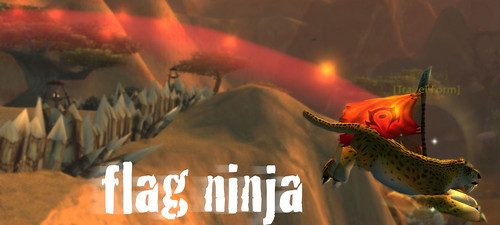
Flag Ninja

This past month or so, I've been feeling the Warcraft Player vs Player love again. Way back when, we all chose to get ourselves onto a PVP server to give the virtual world that little extra frisson of risk. It's been a mixed bag -- bored and decently-geared children (this includes adult children) can "grief" or harass lower leveled players who are just trying to have a little fun. On the other hand, engaging in the defense of towns, or even just turning the tables on an ambusher when set upon out in the world, can be an incredibly fun experience.

About a year ago, Blizzard introduced "battlegrounds," which were specific areas designed for team vs team PVP content. There's a big 40 vs 40 map that -- to some extent -- emulates an actual Warcraft III map. It's interesting, but too impersonal for me (not to mention a multi-hour game). There's also Arathi Basin, a 15 vs 15 map that's sort of like Battlefield 2 -- control nodes to get resources to win. That's a lot more fun, as even 2-4 organized players can make a difference at a node, and the game goes quickly one way or another.

My heart, however, will always belong to Warsong Gulch. This map is straight up capture the flag, 10 on 10. It can be incredibly frustrating compared to Arathi Basin, since it's easier to get into a stalemate (or just get steamrolled). But, but... my DRUID can turn into a CHEETAH and RUN REALLY FAST.

Even if I inevitably die because our defense can't keep or retrieve our flag... there's still nothing like the rush of dodging obstacles and dashing across the field to home base.

This last few months, I've been slowly but surely moving up the PVP ranks. Just this week, I got the superior-grade druid PVP set, which has a speed boost as part of the bonuses, making me as speedy as most mounted characters in the game. Oh yeah, that's right -- that's my dust you're eating.

Yes, my name is Cynne, and I'm a flag ninja.

July 19, 2006

Portal

Valve has released a trailer for an upcoming game called Portal. Holy crap.

July 18, 2006

Titan Quest

Kevin's been talking up Titan Quest this last week, so I finally broke down and picked up. It's pretty fun!

Here's the short version: did you enjoy Diablo 2? Do you ever find yourself wanting to re-install it to relive its joys, and then when you do, discovering to your horror that graphics didn't age worth a damn? Do you want a version of Diablo 2 that has an extremely shiny 3D graphical upgrade, but is otherwise exactly the same game, ripped off with loving care?

THIS IS YOUR GAME.

It's totally Diablo 3, with Greek Gods instead of Christian ones. The animations are even eerily reminiscent. It's crack-tastic.

June 06, 2006

Second Life has too many servers, in danger of eating Internet

Second Life has too many servers, in danger of eating Internet (Broken Toys.)

The "3 users per server" bit is particularly surprising. It sounds, though, like that's comparing apples and oranges. The servers are responsible for bits of land, which -- in SL -- can be pretty complicated beasts. Since the game now charges for land use, not for character use, it actually makes some kind of sense to have your servers scale with land. It's the actual revenue stream, after all.

Still -- 2,579 servers seems crazy big for an environment that's still essentially a novelty until it gets a substantial UI revamp.

May 28, 2006

Fel

Another entry in the "character poster" series.

For some reason, ever since Daggerfall, I've always had a character named Felicia. In WoW, this turned out to be especially apropo, since the word "fel" refers to warlock-y things in the Warcraft mythos. Not that I realized this until a year later, of course. Sharp as a tack!

Fel

May 27, 2006

Epix

drood

For the World of Warcraft nerds in my audience -- yes, I finally started raiding a few months back. I resisted it for a long time -- playing with 40 guys seemed a lot more impersonal than playing with 2 or 5. But then we found a like-minded guild of nerds, and discovered we kind of kicked ass at it.

One of the aspects of playing the game is that when you slay the dragon, you get some nice loot to make you smarter, faster, sexier to all the virtual girls (or guys, or antelopes, or what have you). It's random, so you keep going back week after week, hoping the +5 Boots of Kicking Ass will drop this week, and that you will beat out all the other grubby-handed gearhounds who you compete with... I mean, are part of a big happy family with.

I've had, to understate it slightly, extremely good luck. In the past few months, I've upgraded was already a very nice end-game set into a crazy, all-singing, all-dancing set of healing garb. I play an infrequently played class -- a healing class that, to the uninitiated, appears to be a weaker class because it combines aspects of multiple roles. Since it's infrequent, I tend to get the "phat lewtz" (as the kids say) in a more steady stream than the eight hunters that keep showing up to our 40-man extravaganzas. But it's a satisfying class because of that very hybrid nature, and when properly outfitted, my abilities to heroically keep our band of battle-hardened noobs up and about can be terrifying to behold. Well, I got my Tier 2 Antlers of Omniscience a few weeks ago, and last night.... last night I finally got my Epic Oven Mitts Body Wrap of OMGWTFPWNAGE. So yeah. I'm pretty happy. And far too tired.

It's been interesting to see the difference as I upgrade all of this gear. For the more damage oriented roles, the only way to measure progress is to watch your raw damage output climb up the charts as you compare your virtual phagitude to all the other wielders of arcane mysteries out there. It's all pretty relative, because in the end, you're a wheel in the cog of raw damage output to bring down the fiery lord who resides under the earth. Healing's different though -- with healing, if you expend your own reserves too fast, other people start dying. So healing output, mana pool, and resource regeneration all play factors. As you start hitting the crazy end game stuff, fights go from 1-2 minute affairs, to -- I kid you not -- 8 to 20 minute long epic blastfasts. Suddenly regeneration becomes much more interesting than it had been in what, in retrospect, seems like an incredibly short fight. Last night, I realized that I'd gone from "good effort, but easily exhausted" to "what? are we done already?" As we fought our last, desperate, doomed fight, I heard the other healers cry out around me "I'm out of mana," while I kept on trucking.

Yeah, it's all virtual. Yeah, it's a self-contained world. But... we fought a dragon. And now I have Epic Oven Mitt Bodywraps of OMFGWTFPWNAGE. It's a nice way to end the week and start the weekend.

May 16, 2006

Breaking my head

From the XBox.com page shilling for the intriguing superhero crimebuster Crackdown:

Legendary game designer: This explosive masterpiece, set to define open-world free-form gaming, comes from Dave Jones, the creative mastermind behind Grand Theft Auto and Lemmings.

GTA and... Lemmings. Ow. Head. Hurts.

Man, I miss Lemmings.

May 08, 2006

At long last we meet, XBox 360

Sometimes I'll just get this low level subsonic hum going on in my body that means I've got the jones for some piece of consumer electronics that I've been deferring the purchase of for months. And when the vibration hits -- well, it's good I'm well compensated. Today, the compulsion hit, and it was for the XBox 360.

It's been several weeks since the 360 finally hit production in force -- and several months since release -- and I've been biding my time, telling myself I was waiting for "the killer game" to come out. psu succumbed and has been incessantly talking it up to me, and -- although as of press time he hasn't blogged it yet -- peterb has succumbed to. Cosmic irony requires that we walked into identical Best Buys at the same time today, since clearly the compulsion hit him too. (But how could he resist -- how else was he going to play Oblivion? Too many mind control rays were focused on him, and it was only a matter of time.) And Parrish, a WoW compatriot, has been talking his up for about the same length of time.

So what did I get? Ghost Recon Advanced Warfighter. This has widely been talked up as the prettiest 360 game out there, and I'm here to tell you it's all true. Oh, the textures. Oh, the high dynamic range. Oh, the little screen gewgaws. It's got the same vibe as Rainbow Six 3 from back in the day, but gussied up and ready to hit the burning, desolate town. I played the first few missions from the campaign, and then Parrish and I spent some time with the co-op discovering how we regretted we had but infinite lives to give to our country.

So what's to like about the 360?

  • It's extremely pretty. At first it seems like it might only be incrementally pretty, but then you put back in Halo 2 and play it through the 360, and you realize that no, this is hugely better. Sure, Halo 2's improved on the box, but it only points out how much better something like GRAW is.
  • The Live support has been kicked up another notch. The original XBox Live service is already a sterling example of how to do online gaming right. Now it feels like they've taken a page from the MMORPG world -- messaging is ubiquitous and easily accessed in the same way from within any game. Same with your friends list. The demo & trailer downloading just makes it all the sweeter.
  • Wireless controllers rule. I hadn't realized how much I hated dealing with cords until I tried the new controller. Of course, I have no sense for how crap the battery life is. The ability to actually turn on and shut down the console from the controller is, in a word, genius.
  • I actually like the new controller design a lot. The shifted buttons work for me. The revamping of the black & white buttons into extra shoulder buttons is great. The "Live" button works nicely, and the feedback as to which controller using works well, too. A subtle UI touch -- the same "Ring of Light" quadrant icon on your controller indicating which player you are also shows up in the dialogue blades to indicate who's using the blade.
  • The XBox Arcade stuff is cute and interesting. Hey look, games that require a fraction of the development cost that you can buy online on a whim, for whim prices! Perfect. I only grabbed the demos, though, so they didn't quite seal the monetization deal for me.
  • Apparently Microsoft has a big push to get demos from the E3 stuff out this week to coincide with E3, as well as getting trailers and other content out there. Again, brilliant.

Basically, my only complaint is that you can't start a demo downloading and then let it download in the background while you go play a game.

So yeah, I'm feeling the love. I even like the box design. Yeah, the power brick is big, but it tucks away fine.

April 24, 2006

AMF, pt 2

A followup to my previous post, which Skye brings to my attention: Wired News: How Lara Croft Steals Hearts

MMORPGs as Operating Systems

There's a post from Robert Scoble that's been rattling around in my head for almost a month now: Second Life +is+ an OS.

(Rest of the essay behind ye olde jump to keep my RSS feed from spinning out of control.)

Continue reading "MMORPGs as Operating Systems" »

April 20, 2006

Trying to get a refund

Trying to get a refund on a video game...or, My policy differs from yours: "Yeah, that's a good policy. However it no longer applies to me. I have my receipt and an unopened game. I would like a refund." (via Kotaku)

Tee hee.

April 15, 2006

Adolescent Male Fantasies

I've been trying to figure out what the mass appeal of the Tomb Raider franchise is, and this morning it finally came to me. The game's all about jumping, running, climbing tombs, all while dressed in a variety of stylish women's outfits. Clearly, this game taps into the deep-seated boyhood fantasy we all share of being Eddie Izzard.

Steam-Powered Episodes

They were a plucky young company, with nothing more than a dream in their pocket and a nickel in their eye. They had a vision -- a vision of getting out from under "the man" and making money hand over fist on their own terms. With a couple of modestly successful shooters under their collective belt -- cult favorites about an MIT professor with an attitude -- they were ready to branch out into a brave new world. The brave new world of $20 digitally-distributed episodic content.

The hypegasm for Half-Life 2: Episode One has hit gale force recently, and I -- not being the better man -- was compelled, nay forced, to launch the Steam client and see what digitally delivered delights awaited my decisive declamation of debit card digits.

When last we encountered Steam, we were pretty sad, mainly because it appeared to be all about roadblocks in the way of the CD we'd already purchased. So, this time, I'm trying from the "right" direction. I pre-ordered Sin Episodes: Emergence so that on the day of reckoning, instead of waiting, nay fidgeting, by the phone for my EB dealer to give me "the call," I can simply boot up the machine and get the party started. And, I gotta say, this time the experience was pleasant. They've improved the Steam UI substantially -- now it feels more like a groovy kind of gray, instead of a "Welcome to City 17" kind of gray. And the pre-load experience was much less irritating when I started it, and then proceeded to go play Tomb Raider instead.

The most fascinating and unexpected part was that the original Sin game was included. Man, the things we thought looked awesome back in the day. Wow. Get me out of this crazy time machine!

April 14, 2006

Tomb Raider: Legend

When I went in to pick up Katamari, I wandered by the PC aisle, and found the recent advertising hype for the latest Tomb Raider game washing over me in an irresistible wave. The last time I touched a Tomb Raider game was a decade ago -- after having finally gotten on board with this whole crazy "3D card" revolution, I tried out the demo of the first game, and found myself hopelessly lost and confused.

The series has had a strange history -- the notional game is hugely popular, but every recent game has been considered mediocre at best. So, as time has passed, my curiosity has grown as the series has declined. So now, finally, comes an entry that not only is supposed to be good, but is also designed for the so-called next generation of consoles -- how could I resist?

I have nothing to compare against, but so far I'm finding the game quite enjoyable. I'm probably a third of the way through, and I've found the gameplay all I'd hoped it to be. The core of the game is exploration and puzzle solving, and the puzzles have all been suitably satisfying and epic. The platforming elements are entertaining and well done. The scenery is breathtaking -- the most recent level I've played shifts from scaling up a waterfall to scouring the innards of an ancient temple in a suitably cinematic way. The game employs a depth-of-field technique to great effect, and gets little details like water spray right.

The game's not perfect, by any stretch: gunplay is diverting but simplistic, the camera can be frustrating, and the console mechanic of save points is, as always, infuriating. It can be especially infuriating during the occasional motorcycle sequence, sequences which are brutally unforgiving to poor steering. But these faults, while irritating, aren't dealbreakers. Ultimately the game's action movie sensibilities win out over the imperfections -- there's a sense of adrenaline-fueled pacing that pulls you to the next sequence quite effectively.

One last note on the cinema angle: the cutscenes take a page from the Indigo Prophecy school of interactivity. It's not as involved or distracting as in IP, but it hooks right into that same idea of breaking down the empathy wall and making you believe you're a stakeholder in what's fundamentally a canned action scene. It's great.

Me & My Katamari

I picked up Me & My Katamari (for the PSP) a few days back, because it was one of those games I'd been waiting for forever to show up on a portable device.

And it's very Katamari.

I'm not sure there's much more to say about it beyond that, other than that it puts the PSP's lack of dual analog sticks into stark relief.

April 12, 2006

Blizzard has a sense of humor

First, see this FoxTrot strip. Then see this item that Blizzard added to the game recently.

(Yes, I just got one. HOW COULD I NOT?)

April 05, 2006

Most baffling backlash ever

So, Bethesda (makers of Oblivion), have unveiled for-pay downloadable microcontent for the game. What's interesting is how it has played out: "Swell. Stupid Oblivion Horse Coming To PC" (Kotaku).

Basically, there's a ton of people out there who are very very angry that Bethesda would charge money for new content. Since, as we know, once you buy a piece of software, you are entitled to all follow-on work inspired by that software for ever and all time. This is why developers enjoy releasing software, by the way -- they enjoy entering that period of pure art for arts sake where they simply work on free, open-source versions of software that -- having been sold once -- can never be ethically sold again.

But I digress. What I think is weird about this uproar is that it's over a $2.50 (or $2, depending on if you are an XBox 360 or PC player of the game) piece of content that is essentially a bit of in-game bling. Something that's effectively no different then buying a face plate for your cell phone, or an action figure for a show you like. Or, maybe, a book based on your favorite Joss Whedon show. Did Joss screw you by releasing some content in a micropayable add-on optional form (eg, a comic book or book) when -- if he was a responsible content provider -- he would have just tossed that storyline into the show proper? I rend and gnash my teeth!

Sorry. This whole thing rubs me the wrong way. First off, it's $2. And, unless you're watching old John Cusack flicks, $2 is not something for one to get strung out over. Second off, it's actually a nice little add-on, if you're into dressing up your horsey, and since RPGs are ultimately about dressing things up and then setting them on fire (in whatever ratio you desire), it seems worth it. Should Bethesda have OMG finished the game and included the horse free of charge? To be honest, sometimes you have to stick a fork in it and ship the sucker. And I can't fault them for trying to think of clever little add-ons to try to jump-start this experiment in commerce. It's not like they haven't already completely opened up the mod architecture so that no end of people can make free add-ons of their own. Also, later promised add-ons look like they're even more interesting, and still the same price. And, you know what? I'd pay $5-$7 for actual story content -- I already pay that for story content in other media.

They just want their $2.

March 28, 2006

Dear The Escapist

Why are you so committed to looking like a magazine, but "on the web"? Your text is very very small, and when I try to size it up, it all flies out the sides of your fixed size DHTML rectangles. Hint: your layout interferes with my ability to read your content even more than Wired (back in the day, of course). Cut it out already!

March 27, 2006

Oblivion (one week later)

Does it continue to hold up? Short answer: yes.

It's interesting to see the discussion on the forums where the true hard-core "I like to play Nethack with one save game because it's PURE, man" nerdpolitik-crowd are busy using the mod functionality to do things like slow down leveling, require 6-8 hours of sleep and/or food during the daily cycles, get rid of the quest markers on the compass & map, and otherwise add back in all of the tedium of hyperrealistic simulation that -- for them -- is a big part of the appeal for this kind of role-player.

This kind of Simulationist approach is interesting, but not my own cup of tea. In fact, we've been going through a fair degree of soul-searching in our pen&paper weekly role playing sessions, figuring out where on that GNS tripod our interests lie. Myself, I find I'm interested in the "Narrativist" stance -- I'm growing more and more interested in finding out how a character will react in a situation, and in how a situation leads to a story. I want a sandbox that inspires me to think about the story and motivations behind the face. I find that I'll make versions of characters in The Sims 2 just to play them through "a day in the life" to find out things about them I never knew before.

What's intriguing to me about Oblivion is that I get the same feel out of it. Now, from a gameplay balance standpoint, the mechanic of "use a skill to get better at it" is rife for exploit. Want to become the best level 30 fireball mage in all the land without ever once leaving your quarters in the Mage's Guild? Easy -- just hit the fireball key over and over again for hours on end. What's interesting, though, is that the game tries to level content to match your own character's level. Enter a dungeon at level 5 and it's substantially easier than the same dungeon at level 20. (Again, a topic of much discussion by the simulationist ur-nerds who demand a fixed & predictable world.)

This has a number of implications. First, there's no actual need to "hit level 10 before you can go fight the Lich King of Pickleville." Leveling for the sake of leveling is an almost pointless endeavor. Leveling remains interesting, since your little killing machine toy gets more and more fancy. But really what's going on is that your character ends up reflecting your idea of how you want to play. I have an idea of how I want to play (fireballs, stealth, clever talk), and my little avatar is growing more and more to reflect the fantasy story I've got going on in my head. And, in return, the simulation is throwing events at me that help prompt the story in my head.

Second, I can explore the world narratively instead of from a level-oriented perspective. World of Warcraft controls my progression through the world's lore by making me incapable of surviving in the harsher mid- and end-game content. Oblivion doesn't bother -- I progress through the world as my own story takes me, and the world gets harder to match me. I want to discount the main plot line and get involved with the politics of the Mage's Guild for a couple of game months? No problem. I want to circle around the province and get to know the folks in all of the major towns, instead of haring off into the countryside or delving into dungeons? No problem.

(Although I have done a little bit of haring off into the countryside and delving into the dungeons, and everytime I do, I keep finding a rich set of options to keep my story going there, too.)

As an aside, the NPC AI, while still not capable of sustaining the illusion, still tries really hard, and tries hard enough to let me suspend my own disbelief. The quasi-random bits of NPC conversation designed to deliver rumors to me actually feel immersive, and leaves me with a feeling of personality for the different towns. I'm actually finding myself seriously considering which town I want to dump a load of gold into to buy a house! The schedules the NPCs maintain also add a feeling of life -- it creates an environment where serendipity can occur. And there's enough quests to make me feel busy, so I actually don't have the urge to break into every house and talk to every NPC to make sure I've gotten everything I can. Instead, I follow the big arcs -- the main plot, and the mages guild (and, presumably, the thieves' guild, fighters' guild, and the assassins' guild) -- and in the course of my explorations, doing "normal things" in the towns, I find no end of other side quests to keep me busy.

And did I mention the graphics are incredibly pretty?

Oblivion is making for a nice distraction from the politics and recreational management aspects of WoW. Like WoW, it's almost impossible to play in small chunks. Still, it's got a limited shelf life for me, and I acknowledge that. I've gone through my obsessive spurt of exploring the landside, and now I'll almost certainly settle down to finishing off the mage's guild & main line quests in smaller spurts of time, and probably set it aside. It's got legs, though -- the next time I'm feeling the yen for a single player dungeon delve, I'll probably fire it back up and pick up one of the other guild lines, or just find a random dungeon to loot. Has it slain WoW for me, though? Nah. This is reading a great interactive adventure novel. WoW is playing in a community orchestra -- ultimately, the gameplay itself retains more depth and stands up better to repetition. Yeah, I'm doomed.

March 22, 2006

The Elder Scrolls IV: Oblivion

The code that has been gnawing at me for the past week is finally in, so now I feel comfortable taking a few moments to discuss Bethesda's at-long-last fulfillment of all of their promise: The Elder Scrolls IV: Oblivion.

I came "late" to the series -- I started with TES2: Daggerfall, and proceeded to play Battlespire, Redguard, and Morrowind. Yeah -- that's right -- I played Battlespire. Probably got about halfway through it, too. Every one of these games showed a hint of a world that these passionate, passionate guys wanted you to dig deep into. They had a vision, and by god, they weren't going to compromise that vision, even if they still weren't quite sure how to make it all work.

Well, my friends, I'm here to tell you that they figured it out.

Now, most people will get in your face about the graphics of this most recent installment, and get me not wrong: the graphics are awe-inspiring. And I'm saying that from the perspective of not even having the latest & greatest video card -- my "creaky" HL2-capable box is still making me swoon with the medium-grade graphics option. And the physics engine? Non-gimmicky. Watching that rat fly backwards after the very first fireball leaves your virginal adventurer's fingertips -- well, that's money, baby. That's money and it doesn't even know it.

But I started playing with Daggerfall, baby. I'm old school. I'm thrilled about the graphics -- but that's not why I'm here to gush at you today.

Remember all the things you liked about the previous games but at the same time were tearing your hair out about? Remember the awkward dialogue system? Remember how, in the end, you just learned some stupid no-mana fireball spell and camped out in the mage's guild, putting your character through a weeks long regimen of fireball until you drop just so you could level up destruction? Remember loving how big the world was, and then quickly feeling like you hit the weird, random, far-too-hard spot?

FIXT, my friends. FIXT.

Let's start with the hallmark of the series: the idea that you level up by doing the things you're good at. In every single game, your class is defined by a set of skills that are core to it. And you level those skills by using them. And you level up by leveling the important skills. It's a great, great idea. And eventually, you wonder why the hell you can't fight the rattly old skeleton and whether you've made a huge mistake, because you're LEVEL EIGHT but can't cast more than two fireballs before you fall over. And then you spend four hours casting a training spell over and over again, because it's easier to do that than trying to train up in the dungeons.

Well, so far at least, I'm actually leveling up my skills by adventuring. I haven't hit the Irritating Bastards of Doom despite several hours of play. My mana actually recharges (!!!) without having to sleep, so playing a fire-slinging spellcaster feels actually viable. The combat system feels more visceral -- targeting that oncoming guy and casting maaaagic miiiiisle makes me feel like a wielder of Dread Powers, not some shmoe. It's hard to quantify -- but it's there, and it's great.

NPC interaction? Well, there's still the reaction score and the keywords you'll remember from previous games. Influencing the reaction score is more of a mini-game now, though, and I don't mean that in a bad way. It's just enough meat to it to make it interesting to play, and not so much that it feels like it supercedes your actual speechcraft attribute. And, unlike Morrowind, it doesn't feel like you immediately get into a "reactions are so bad I can't possibly ever fix it" state. The keywords are back, too, but you don't immediately get into having 50 keywords to click through for an NPC, and things like rumors seem to only change daily. It's enough restraint to actually make the characters seem more interesting.

What's even better about NPCs, though, is that they actually have schedules. This seems gimmicky, but it turns out not to be. The schedules are well done, and you can get hints about them from talking to other players, so it actually feels like something you can plan around and make educated guesses about. This, in turn, adds to the immersion. They'll even go through doors into other zones, and be there on the other side when you follow them.

Another nice feature is that when NPCs meet in the street -- they'll talk. This is a really slick way of introducing quest leads and world rumors. You just sidle on up to the conversation and make careful note of interesting plot points. If you don't care -- you can move on.

The quest log is also nice. It actually tracks completed vs current quests, and allows you to make a particular quest the "active" one, which means laying out all of the stuff that has transpired in it, and affecting what waypoints show up on your map.

Quests are so far pretty interesting, too. I quickly ran up against a quest where two people wanted me to do two different things. I was interested in satisfying both, so I gave the macguffin to A, let B chew me out about getting it back, waited for A to unlock the macguffin, and then stole it back and gave it to B. Wooo!

Basically, playing this game FEELS like playing what my rose-colored glasses tell me playing Daggerfall was like, and what I wanted playing Morrowind to be like. Hell, throw in the fairly cool if non-accelerated FPS-action of Battlespire. I'm loving it. If you liked the series at all at any point, you'll love it too.

February 12, 2006

Star Wars: Knights of the Old Republic 2

I picked this up on the cheap a few days back. It's interesting that Bioware/Obsidian are clearly better stewards for the Star Wars universe than George Lucas is. In their hands, it's a rich & interesting place with a lot of history. Lucas, on the other hand, treats it like the flat facades of a "town" in a Western. I know he wanted to get that Republic serial feel, but I mean, seriously. What up, dude?

So, yeah, I'm liking what I'm seeing a lot. It's also reminding me of how much I preferred the KOTOR combat system to the quasi-fighting game style of Jade Empire. I haven't much urge to go back to JE just because I always felt like I had a 50/50 chance of having to go back to a save game every time I got into a fight, and yet they didn't autosave for me before the fights. Bleah. It's too bad, because the story seemed pretty interesting.

January 24, 2006

Auto Assault Beta

This almost slipped past me -- Penny Arcade has Auto Assault Beta codes for a beta event this weekend.

Auto Assault is a post-apocalyptic car-drivin' MMORPG. Think Car Wars.

Booth Babes banned at this year's E3

The E3 at long last grows a spine.

(Via Games @ The Guardian.)

January 18, 2006

City of Heroes offline character creator

Special for peterb, who no doubt already read this Joystiq, since we all know he has no shame either: Create a superhero - offline (Joystiq)

(Note the instructions link for running it in English.)

January 17, 2006

Bye bye Paragon City

Watching Teen Titans definitely reinforced the same superhero nostalgia trip that was at the heart of my time spent in City of Heroes. I didn't realize it until I started watching the show, but my main blaster shared some eerie similarities to Starfire. COH was a lot of fun to play; it helped me understand the appeal of the mass RPG without the high leadup to having fun that a lot of the examples of genre had at the time. As Kevin has pointed out before, COH dumped you straight into the "hey, you're a hero -- go beat up the badguys!" No killing of ten rats for you!

In general, the game had a great casual flavor. Highlights included:


  • Right off the bat, you could make your own costume, rather than spend hours/days/months searching for the +10 Robe of the Bloviator.
  • Instanced missions were always scaled to be appropriate for your group -- there was no requirement that you spend an hour forming an appropriate team.
  • Travel was mostly fast, once you got past level 14.
  • The teamplay was always fun and fast-paced.

Unfortunately, the strengths also turned out to be weaknesses. The accessible nature of the content, in many ways, makes it feel trivial. You do the same basic set of missions over and over again, in randomly generated dungeons that don't substantially differ from each other, so the randomness mainly just means you have to explore how the nodes intersect yet again. The level grind gets painful, quick, since in the end, that's all there is to do. There's no real in-game economy, or ability to differentiate your character outside of combat.

What I had the most hope for was the base building that was introduced with City of Villains. Unfortunately, base building turned out to so oriented towards massive teams grinding for reputation that it was completely inaccessible to the casual players that heretofore, the game seemed solely aimed at. Now, all the sudden, you DID need a forty man team of heroes grinding for rep. And, in the end, my heart just wasn't in it.

So, when my debit card got lost last month and I had to cancel it, and when NCSoft sent me a polite e-mail about how they cancelled my account when the old card # was declined, I realized that I was done being sentimental about characters I wasn't even playing anymore. Cya, Paragon. It was a lot of fun. Really. But it turns out I'd rather be riding my giant horse made ENTIRELY OUT OF FIRE or turning into a bear or something.

January 16, 2006

The Matrix: The Path of Neo

I'd picked this game up a little while ago, since the reviews made it out to be "the game we wanted Enter the Matrix to be." That is to say, a game that hewed more closely to the plotlines of the movies, and that had a higher fun to dreck ratio. Also, the Agent Smiths turn into a giant robot at the end, after a little self-mocking cameo by stick figure versions of the Brothers Wachowski. (No, Really.) Unfortunately, it also turned out to be picky about my clearly non-standard Soundblaster Live! card, so I grudgingly went and picked up an SB Audigy, although, let's face it, the odds are that my gaming needs (with my little crummy two speaker setup) could possibly require the services of something more complicated than the cheapest of audio solutions are pretty low.

But yeah, I bought the card, then got distracted by other shiny things (as opposed to by the existing Shiny thing -- ok, that was a reach), and the card sat on my floor over the holidays. Yesterday, I finally picked it up again and installed it, and -- huzzah -- the sound works in the game now. So, imagine my bitter and yet somehow expected disappointment with the actual game.

I don't know if my expectations have shifted, but I seem to recall the one thing Enter the Matrix did OK was faces. The hullaballood scalable graphics meant that, sometimes, just sometimes, you saw some really pretty, highly detailed textures and pretty areas. That appears to have gone out in the window in the meantime. The main thing I noticed when turning the graphics slider up to 11 (well -- 8 -- they really should have made it max at 11) was the introduction of a "blur" effect that really just made the graphics seem lower rez than they were.

I was also looking forward to seeing movie footage interspersed with gameplay elements -- making it feel more like watching the movie with playable bits. However, the footage has been recut by somebody who gets bored watching MTV, to give you a little "previously on The Matrix" feel. Skip skip skip. Skip. Oh goodie, now I'm back to the savepoint-driven gameplay.

The gameplay itself is trivial. Jab the one and two buttons to create "combos." Get weapons that will break after a while, and don't have a significant impact on how your gameplay evolves. Do "stealth" content that involves moving from green highlighted area to green highlighted area. From the very get-go, the gameplay diverges substantially from the movies -- instead of getting caught by the agents, Trinity rescues you on her motorbike. Whoah. Bored now.

Once you get through the initial area. you're dumped into a tutorial that reads like the Quentin Tarantino fanboy theater. Learn how to do the four-hit combo! It's only a 20-minute tutorial against a Japanese sword master! I know sword-fu! Hmmm, wait -- I'm not sure I understand how to press the first button four times. Thank god the tutorial is 20 minutes. To be honest, this is where the game lost me -- I did 3 tutorials, and then discovered there were something like 30 of them. When I finally got to the end boss on the third tutorial, and lost, and discovered there was no checkpoint, I "jacked out." "Took the blue pill." "Went back to leveling up my rogue in Azeroth." Whatever the cool kids are saying these days.

So yeah, for the nonexistent person who (a) reads my blog and (b) might have gotten suckered into this game and (c) hasn't done it already -- um, don't do it. Go play God of War instead. Now there's a self-involved violent fantasy setting that I can get into.