Puerto Rico: El Yunque
This is about a month old now, but here's a second round of shots from Puerto Rico. These are from El Yunque, the National Park-operated rain forest.





This is about a month old now, but here's a second round of shots from Puerto Rico. These are from El Yunque, the National Park-operated rain forest.
I just picked up Fallout: New Vegas, which despite some annoying bugs (the most vicious of which is a problem where my quicksave files disappear when I relaunch the app) is a lot of fun and a good continuation of the Fallout saga. But this post isn't really about that; it's about how CRPGs structure narrative.
F:NV got me thinking about this because it's fairly natural to want to contrast it with Fallout 3, let alone Fallout 1 & 2. But Fallout 3 is an odd game, heritage-wise, because on the one hand, it draws deeply from the narrative structure pioneered by the Elder Scrolls games, like Daggerfall or Oblivion. On the other hand, it's tonally a pitch perfect successor to the original Fallout franchise. And yet, at least in terms of narrative influence, Fallout 1 can pretty directly trace through all the way to games like Mass Effect. (Fallout 1 was the impetus for the Black Isle studios, the Interplay division that revitalized CRPGs in the 90s, and led to a little game called Baldur's Gate.)
So what am I talking about when I talk about narrative structure? Really, I'm talking about the gameplay devices that are used to get you through a finite plot while still providing the illusion of free will for your game avatar. After all, CRPGs are limited in scope based on art, voice, and text all put together before you even start playing the game -- but the social activity they are meant to emulate is much more flexible. So it's important to CRPGs to make it feel like there's always more beneath the surface, even if there isn't.
So here are some thoughts on common approaches to this problem. The labels are for convenience and for reference points -- I'm not claiming all JRPGs behave like I describe, or that only Bioware has a lock on the "Bioware style" I describe.

Once could alternately call this the "Final Fantasy" style, although it's held true for many of the JRPGs that I've played. These games are characterized by colorful characters, vast sweeping panoramas, and bizarrely impassable hedges. Like more first person shooters, this style of CRPG relies on spectacle to distract you from the inability to explore. Exploration, if it exists, is usually in the context of narrow spurs off of dungeons that contain some collectable item, rather than new story paths. Subplots are almost non-existent.

The Bioware style -- which is also really the Fallout 1 style -- is characterized by major quest hubs. There is sometimes gating between hubs; for example, a major quest in the intro area you must complete before you can essentially leave the tutorial. Gating may or may not exist for the interior nodes (games from Bioware itself are almost clichéd for having a starting hub, three interchangeable hubs in the mid-game, and then an end sequence) and then there is usually a conclusion area that locks off previous areas.
In each of these hubs, there are usually multiple quests and storylines. Only one storyline tends to exist pre- and post-hub though, which is typically the "main quest." This quest will usually also provide the breadcrumbs that get you into this area, and then conversation with NPCs will tend to drive the discovery of smaller, self-contained stories that illuminate aspects of the hub, or introduce you to new companion NPCs.
This style of game is less likely to keep you on a specific path (Fallout 1 had a very large explorable area, for example), but it's still not always the case that if you see something you can travel to it and explore it. (Jade Empire, for example, had forests where you could not venture off the path.)

The Bethesda style is arguably the most daunting. In Daggerfall (I can't speak to Arena, although I gather it was a simpler variant on Daggerfall), story was almost nonexistent -- or at least largely left to the player's imagination. There were several stories, which mostly consisted of breadcrumbs to get you into dungeons, but they are almost never directly connected.
Oblivion and Fallout 3 continue this tradition. In Oblivion, you are directly set on the main quest, but it only brings you near the other questlines -- it never connects directly. Finding most of the Oblivion side quests requires actively poking around. Fallout 3 borrows somewhat more from the tradition of bringing you to an area filled with NPCs that will direct you, but again it's more often than not that what takes you to a new story area is seeing something on the horizon, and going to check it out.
Interestingly, New Vegas harkens more back to the Bioware/Fallout 1 style. It takes place more in open desert rather than destroyed urban area, which tends to emphasize the quest hub/NPC style. However, it's still true that if you see it, you can generally get to it. It's making for a nice synthesis that in a lot of ways is really bringing the two major western CRPG approaches together for the first time.
The last few Saturdays, I've been trying out my iPad for our D&D sessions. I've used a variety of technologies over the years: paper, laptops, smart phones, and now tablets. Sometimes it feels like more effort than it's worth, but fundamentally I feel like my nerdy toys should support my nerdy habits, if you know what i mean.
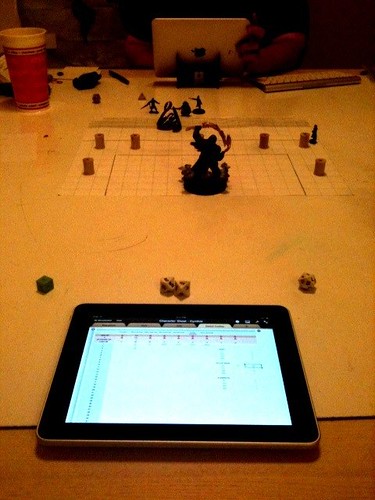
So what's the best use of smart paper (ipad, whatever) with tabletop gaming? Dice, shared boards, and rule checks are obvious but unsatisfying answers. How far do they take us? Better answers seem to revolve around simplifying repetitive tasks, but D&D4 already does a nice job of this with the character builder & the cards it prints out. So where's the sweet spot?
Week One: Spreadsheets
The first week, I focused on making a character sheet, using a spreadsheet. I entered most of the statistics supplied from the standard D&D character sheet, with a thought towards having a convenient reference. On a whim, I also created a sheet to track damage done to monsters, and a simple formula to guess total monster health based on when the monster is bloodied.
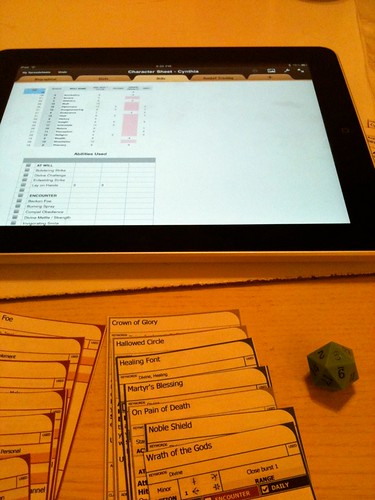
What was most interesting to me was it was the last piece that was what I used the most. The recapitulation of stats was fine, but it didn't add much to what I could get from having a physical piece of paper in front of me. Tracking the combat, on the other hand, gave me a fairly visceral way to see what was going on in the fight.
Week Two: Web Apps
Yesterday, I decided to try a different tack. My DM has frequently talked up a web application named "iPlay4e," which takes the ddi files generated from the Character Creator app, and turns it into an interactive, web-based character sheet.
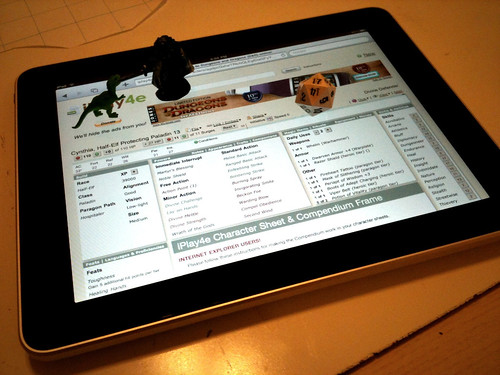
I had tried iPlay4e before, but it hadn't stuck. The iPhone view is pretty nice, but you just can't see enough information. Also, while you can "share" character sheets, only the original owner can use it interactively. By interactively, I mean that they can do things like track health, which abilities have been used, how many action points have been used, etcetera.
I finally uploaded my character sheets to my own account, and tried the interactive features out. I was pretty surprised to find that they were real game changers. There were two important differences between my spreadsheet efforts and iPlay4e. The first was the general level of polish for tracking all of the little details that one has to track in a gameplay session (and support for the normal ways of refreshing those resources, like short and extended rests). The second was a little thing called the D&D Compendium.
The D&D Compendium is a part of a subscription-based service offered by Wizards of the Coast. It contains all of the snippets of rules texts contained in all the 4th Edition D&D books, including errata. It has a searchable and filterable database of rules, items, classes, etc.
I've subscribed to this service for a few months now, but I didn't use the compendium much. It was somewhat awkward to use on a phone's screen, and lugging a laptop back and forth to gaming is not the best solution for me. (More on this topic later.)
Using it with a larger screen was again, a revelation. Suddenly I wasn't dragging four or more books around (I've taken to leaving the books in the car, for convenience). And the best part is, the compendium is integrated with iPlay4e, so suddenly my character sheet is directly indexed into the books.
In short, I loved iPlay4e. I made a donation to the author during the play session, because I thought it was so cool. I wish I'd listened to my DM earlier.
Why the tablet?
So... why don't I just lug a laptop? I have in the past, and have worked up elaborate spreadsheets & dice roller apps (ranging from GUI-based to perl-based). The reasons can be summed up as follows:
The latter point is the biggest issue: attention span. Having lots of windows means that if the game slows down, you've lost me. And there's a big damn wall in front of my face, so you don't even know if you had my attention in the first place. Laptops suck, because they take you out of the social interaction.
I've been using my phone, since the iPhone and other modern smartphones have finally introduced real web browsers and chat tools to a small form factor. But the tablet is big enough to use data visualization, and small enough to carry around without it being a thing. The battery life on the iPad in specific is also a huge factor -- there's zero chance I'm going to bother carrying around extra crap like a power adapter, because there's zero chance I'm going to run out of juice. From this morning's charge to this evening's writing of this blog post, I still had 30% left after a day's usage.
Also, new nerdy toys are fun. I like to dip my chocolate in my peanut butter.
Why not paper & books?
I will say that I'm resisting the urge to use dice rollers. After using many over the years, I currently feel like if I'm not actively rolling the dice, I'm not playing the game. The D20 is iconic to this game in particular, and I'd like to hear it hit the table.
The WOTC software tools for D&D4e are great, if regrettably not available for the Mac. Being able to print out character powers and items with the roll formulas computed for your character is huge. I honestly didn't feel the need for any kind of software solution for quite a while. That started to change as I hit level 10 and higher though, and the number of cards I was juggling became difficult to manage. If iPlay4e did nothing else, it wins by sorting my power "cards" by what phase they can be used in, and how often they recharge, and then letting me "check them off" as I use them. This does solve a real problem that I was having trying to use the cards, once the number of cards got unwieldy.
The spreadsheet is nice to have, although I freely admit it's mostly me trying to reverse engineer the monster stats based on observable phenomena, since I don't get a running hit point count or monster defenses level. I used to track that on the whiteboard that we game on top of, but as the maps got bigger and the number of cards grew, I lost valuable whiteboard space.
The books have just gotten heavy, now that I own four or more. I'd love to avoid having to carry them all.
So what have I learned so far?
In 1997, I took the first trip that I actually tried to document and write about. I was a grad student, and I went to France with the other members of my research team to go to a research conference. I was also a relatively recent owner of a PalmPilot Pro, and so I furiously scribbled out a series of e-mail missives for later sending.
In 2001, I found the analog photos that I took of the trip, and finally put the e-mails & scanned images together into a Paris 1997 travelogue.
(The next big trip like this was Paris in 2005 with Carrie, but I phoned that one in a lot more, with just a few shots posted to my blog, apparently.)
The next whack I took at this was the Christmas 2008 trip to England. My approach this time was to take a large number of photos during the day, then upload & edit them that night, and make a coherent blog post for the day with -- usually -- no more than three photos as highlights. This shows up on the December 2008 and January 2009 archive pages of my blog, although, regrettably, the reverse chronological order suffers for later reading.
The trip to Hawaii we just returned from, on the other hand, has no tangible record, because I posted it mostly to Facebook, which is generally walled off. You can piece it together from my Facebook wall, since I generally don't use the privacy settings, but it's still not put together in any kind of coherent form.
Granularity and Community
Of the three, I think the first one stands up best as a piece of writing. Yes, I have ten years more experience under my belt now, but it was actually written to be read later. It probably tells the best story for someone who's interested in the trip after the fact.
On the other hand, the Facebook entries were the most satisfying for me. Since I was working from a facebook-enabled cameraphone, I felt like I could show interesting things as I encountered them, and getting comments as we explored gave me a real sense of remaining connected to community. I recognized that I was probably splatting out about twice as much information as people really cared about, but we were having fun and seeing interesting things, and I wanted to share that enthusiasm. In a very nerdy way, it was sort of like the kind of community I get from being in an MMO -- I can engage in my own activities, but I can share those activities and use it as a springboard for conversations.
By contrast, the blog entries generated almost no commentary, making them feel much more sterile to me. I got a sense of craftsman's pleasure from making them, but once they were out there, they already felt somewhat adrift and context-free.
Technology Evolution
Obviously, a number of these technologies have shifted on the spectrum: digital cameras have become portable and have great quality now. The very idea of being constantly connected to the network is plausible in a way it wasn't even a few years ago. And being able to take a picture and post it to Facebook from the open seas encourages both a spontaneity and a logorrhea that still demand a new kind of a writing style to be worked out. As I write this, I realize that I'd really love to have a good way to take snippets of writing that I'm -- for lack of a better word -- beta-ing on Facebook, and pull them back together into a narrative that stands alone.
The GPS angle is also somewhat interesting, although I rarely used Twitter to tell any of the most recent narrative, and Twitter has the most robust geolocation. I used Gowalla to some extent, but I have the suspicion that people either find geo-social-blah-blah either fascinating or incredibly boring, and there's almost no in-between. I also messed around with an app called "Trip Journal," which tries to produce a map of your journey along with associated pictures. It's reasonably well done, but in the end it was too much of a hassle (and too much of a battery drain), and the options for getting the story out of the app didn't really fit my needs.
I'm curious to hear others' reactions to these different forms of storytelling. Is it interesting? At what point does it become too much? What ways do you document & retell your stories and adventures as or after they happen?
In Conclusion...
...here are some badass pictures of humpback whales that I took:


We've been re-watching ST:TNG lately. It was a good show for me as a kid. It espoused an idealistic view of humanity. It was pro-science and pro-rationality. Every problem could be solved in short order through communication, intelligence, and gadgetry. It's clear to me in retrospect how this show helped form my own ideals and attitudes.
Unfortunately, two decades later, the show's flaws are more evident. The "Rubber Science" of Star Trek is, of course, a long standing joke. But what's truly striking to me now is how pervasive the problem is. In literally every episode, some dramatic new technological event occurs. I've just watched two episodes in a row where eternal life gets invented. In the first, the ability to download brains to computers! In the second, the ability to use the transporter to filter out old age!
These are interesting and deep ideas, well and truly explored throughout the sci-fi literature. But in Star Trek, they're just part of a fusillade of the sci-fi smorgasbord that's being hurled at us. In a good sci-fi, these kinds of ideas are used as a backdrop, and what becomes interesting is the exploration of the societal impact. But Federation culture is impervious to change. The Prime Directive seems to apply more to the Federation itself than to the noble savages they continuously encounter. Disruptive technologies assault the crew of the Enterprise on a daily basis, and yet they rise above, serene, impermeable.
Perhaps this is why Babylon 5 was so attractive; it was arguably the first modern sci-fi show that acknowledged that change happens. Re-watching Firefly in the past few days (in between discs of ST:TNG, since Firefly was so mournfully short) also demonstrates a sci-fi universe where technology has cultural implications.
Here are some examples in the past two decades of ideas that would have been throw-away plot devices in ST:TNG:
For example, seven years ago, the iPod was just coming out. Now, iPhones, Droids, and Pres have dramatically changed the way we look at computing. Where, in ST:TNG's seven year run, is the impact of ANY of their throwaway ideas shown? I'd argue the closest Star Trek ever comes to this is the Holodeck, a technology introduced with the first episode, and which ends up having great impact on the social interactions of the crew.
The show is nice to re-watch, largely because it does harken back to a simpler time. After a stressful year, it's nice to watch a fairly low-impact and innocuous fantasy, where people are just fundamentally trying to be nice to each other. But the elephants in the transporter bay are hard to overlook.
One of the enduring fixtures of my time in Austin has been Saturday gaming. We've gone through a variety of systems in our time, including GURPS, a couple variations of D&D, and some pretty interesting indy systems (and some Mary Sue-tastic stretches of freestyle storytelling). Of late, we've been playing Dungeons & Dragons 4th Edition, and having a blast doing it.
D&D4e has streamlined a lot of the combat from previous incarnations, and, dare I say it, made it actually fun. In earlier incarnations, I had special abilities, but I never particularly felt encouraged to use them. In 3rd Edition especially, I felt I spent most of my time doing auto-attacks. 4th edition almost falls over itself to throw a variety of powers at you, though, and most of them are one-time-use, so you're actually encouraged to mix up what you're doing. Because the combat is more fun (and also because good GM software tools are provided to ease the creation of encounters), we find we pull out the grid map way more often then we ever did before.
At some point when we were doing this, Kevin -- our GM -- started trying to take pictures of the board as we were going. He'd been inspired by the Penny Arcade d&d session twitters. I found this to also be pretty interesting, especially with the following combo platter of geek tools:
I do have a blogging app on the iPhone, but it's way more annoying to use. So I thought I'd take the time and put together a longer entry on the phenomenon and output of this.
Beginnings
I started using the camera just to document stuff that I'd put on the tabletop whiteboard, in case it got erased before the next week. For example, here was an experimental system we used to track a particularly amoral character's swings to and from the dark side:

I took the shot as a quick and dirty way to make sure I knew how the points were laid out between sessions. This actually predates GM Kevin's interest in the PA twitter feeds.
Here's another example, where I was tracking gold & XP for my character on the whiteboard (our GM has moved to tracking this stuff via a D&D oriented wiki space):

The dapper gent with the multiple legs and the top hat is the famed "pattern spider," who likes from time to time to jump into our games and dump lots of exposition on us. (As I recall, the in-joke here is mostly making fun of me, for badgering Kevin in an early game to explain the whole mystery through this one NPC that had the grievous loophole of having an omniscient viewpoint. For some reason, the spider had a fancy hat and a cigar and a Brooklyn accent.)
Action shots

Here we see my first effort. Note how masterfully I tank the dragon away from the group, putting all of my hard-won World of Warcraft experience to bear. (A few turns earlier I'd let the dragon turn and toast everyone >_< )
Later on, I picked up Camera Bag, which had handy pre-canned photo effects. I became a quick fan of the vignetting here:

At the end of the day, the iPhone camera is fine, but it's not going to shine in a room that's only lit by some normal light bulbs. So I'm kind of trying to embrace the grainy, cruddy nature of the cameraphone with this. Also, it's in Fantasy Past Time, and thus should be colored in the style of a Wild West Poster, which was pretty much the same timeframe.
Later on, GM Kevin picked up the aforementioned TiltShiftGen, and started FBing pictures that were clearly manipulated with it. A tilt shift lens (or software program used to fake the effect) provides a very distinctive dollhouse style, as you can see at the linked website.
I've only used it a bit, and I will freely confess that I actually am using it even more for the color sliders. But being able to fake a depth of field effect is pretty nice. The main problem I have with it is that it degrades pretty quickly at the cruddy resolutions & qualities that I'm capturing in this environment. But still, I was pretty happy with the ominous result obtained here:

Several good games came out recently. There are plenty of people who will (correctly) tell you to pick up Torchlight, or Borderlands, both of which evoke the spirit of Diablo in different yet very awesome ways. I've also been finally trying out Halo: ODST and liking it very much. There's even a few new MMOs out -- Champions Online and Aion -- that are both beautifully flawed in their own special ways, and probably deserve a little blog action. But I'm not here today to talk about any of those fine games with you.
No, I'm here because I want to share about a game that wants to crush your soul.
So, I keep hearing about this game, "Demon's Souls." I keep hearing that it's hard, it's unforgiving, and then -- my favorite useless piece of information -- that "failure just means your strategy was wrong." Nobody actually described what any of this stuff means. So here's first impressions, if you're wondering about this game. Sneak preview: it's cruel, but captivating.
First off, this game does not want to be your friend. There are absolutely no story breadcrumbs in the first few hours that I've played. At some point, when the game wants to introduce you to a particular gameplay mechanic, it just puts a boss that will one-shot you in your way. "But Eric," you say. "OMG spoilers!" you say. To you I say, shut your damn pie hole, this information is not going to actually help you in any useful way.
Character creation is terrible -- you have lots of sliders, all of which affect other sliders in obscure ways, and all of which basically turn your character from Moon Boy into The Kid From Mask with the merest flick of your wrist. There is literally no setting of the face sliders that doesn't result in a deformed creature from beyond the widdershins dimension -- which, now that I think on it -- may just be another metaphysical statement the game is trying to impart.
The game prizes exploration. Almost nothing is explained. Any explanations you find are going to come from your fellow players. Because, in a way, this is the most lonely MMO you will ever, ever play. Did you die? Your bloodstain will show up in my game, and if I see it and click on it, I can watch you vainly fighting against an unseen foe, and perhaps gain insight from it. You can leave me messages. The messages are from a heavily templated menu-driven system, so your messages will actually all be grammatically correct, and filled with thees and thous, but if your message is helpful, I can send you a heal. Sometimes your ghostly form will appear on my screen, going about ghostly and mysterious tasks.
So when we play, we play in the same world, and we see each other -- but only in dim echoes that remind us purely of the futility of our own struggle against the demons. Also, there's no /trade chat, and that's pretty cool.
The game kind of starts when you're dead. Dying causes you to leave a bloodstain on the floor and restart life as a ghost -- a ghost that can basically do everything your living self can do, but just has half the health to do it in. At this point, the game will remind you of when you played Rainbow Six, because you'll have to venture through this dungeon to kill the big bad at the end. And on your way you will die... a lot. And when you respawn, you'll re-fight through the same dungeon with the same enemies doing the same things. So when people talk crap about how "dying means your strategy was just wrong," they basically mean "dying means you didn't remember that the one guy with the flaming eyeballs jumps out from behind the wall when you get to step 413, and you didn't counter with the witty repartee maneuver... GOD."
Should you manage to win your way back to your bloodstain though, well, good news: you can get the XP back that you left in a puddle on the floor.
So, nothing is explained. The manual is useless. Mana doesn't even regenerate unless you start out as a coddled Royal, who's looted the royal treasury for some nice gear. Progress is a combination of exploration, experimentation, and memorization. At any moment you could be set back to where you started and have to replay 10-15 minutes of your ghostly life again. Why the hell would you even play this game?
What can I say? The combat is BADASS. Blocking, riposting, parrying, combo moves, some magic thrown into the mix -- it's exactly the kind of fake-fantasy combat RPG model I've always wanted. The inner loop of this game is more fun than the cruel outer loop, and that's what drives me on.
Also, I think about that poor ghost still wandering around that castle and I feel bad -- maybe this time I can win through and re-unite my avatar with her mortal coil. Maybe. I'll probably just get pissed again though and play something else.
I told myself I wasn't going to be one of "those" Prius drivers. "I'm getting this car," I told myself, "because this is a nerd toy. A geek luxury device. Because, in short, it is from the future." I wasn't getting the car so I could become obsessed with gas mileage, and correct drivingthink, and so that I could enjoy the curiosity and adulation of fellow drivers.
And I wasn't. But they put a videogame inside my car, and it's not my fault.

I've had Saturns since I've had cars. This is my third car, and the first two were both variations on the Saturn sedan of the time. At first, I really liked the philosophy of Saturn, but over the past several years Carrie & I have both become fairly disillusioned with the increasingly poor customer service. After spending several hundred dollars to get an issue fixed with my Ion that ended up not being fixed anyway, requiring further repairs, I pretty much gave up. The Ion had been a Fine Vehicle, but I was ready for something... sexier. Cooler. Dare I say... Nerdier.
When I went shopping for the Ion in the early part of the century, we test drove the first version of the Prius. Regrettably, it kind of sucked for such tall and leggy people as ourselves. That, plus the incredible waiting lists for hybrids at the time, caused me to put the idea on the shelf of wistfulness. But now that a car replacement was on the table, Carrie's research found that the current cars had been substantially re-worked inside. We went to go test-drive a second generation Prius, and were pleasantly surprised. It felt roomy and awesome, handled well, and it was full of status displays and readouts.
Far forward to a month or two later. Research had been done. Pondering had been pondered. Hate for current car had escalated. Remaining administrative details necessary in order to unload old car had been dealt with. My car title was in hand, Apple stock was reasonably up, and I was ready to enter the future.
Technological Terror
Those who know me will be unsurprised to know that I'm a fairly pragmatic liberal. My general rule of thumb is "try not to suck." I'm also probably the very definition of technocrat. So ever since I first heard about hybrid cars, my first thought was, "well, duh, that seems obvious -- why doesn't every car do that?" I mean, when I was 12 and didn't understand about things like entropy, I didn't understand why a car couldn't just run off the friction from spinning the wheels.
Well. Happy day.
It's important to note that the futurecar is not a magic bullet. Despite being rated at something like 50mpg, it'll still perform in fine mediocre fashion if you're spending lots of time between stoplights, accelerating a lot. (Where "mediocre" here is defined as "still better than my Ion" -- but more like 30mpg than the advertised 50mpg.) It'll also be totally happy to perform like a dancing pig if you drive it like one.
But they put this videogame inside my car, see.

It's a little bar. And when I accelerate, the little bar fills up. And if I can keep that little bar in the lines then I get more experience points! Or something like that. Maybe my combos fill up faster. All I know is that suddenly my car has a competitive angle.
I can also flip to this other display where I can find out how fast my XP is piling up:

Yeah -- a bar graph that breaks down my XP gains over the five minutes, or even by every minute. Honestly, I don't know why they didn't make the graph continuous like a CPU meter. Oh right -- it's because I'd never watch the road, and crash into a bus full of school-children who were on a science field trip. Because irony works like that.
So like I said. It's not my fault. They put a video game in my car. And now I'm determined to do better than that lame-ass 30mpg showing I have from the first 200 miles. Seriously -- what a noob.
Geek Luxury
But like I said, that's not actually why I bought the car. Remember that picture from the top of the entry? I bought the car because it looks like a goddamned spaceship. I seriously feel like I should be able to dock with a Federation starship in this thing. I'm continually searching for the laser beams.
My favorite feature -- especially in light of a problem I had with the Ion involving keys -- is that this thing is essentially keyless. I have the little keyfob, but in day-to-day operation it never comes out of my pocket. Here's how you unlock the car, assuming the keyfob is near the car:

Yeah. You pretty much just put your hand on the handle and pull. Here, then, is how you lock the car:

Words cannot describe how giddy this makes me.
Inside, the car looks like a spaceship as well:

You can't really see it in the picture, but there's actually a fair degree of three-dimensionality to the console display. Including, if you hold down buttons on the steering wheel, you get a little heads up display around the MPH readout:

Generally, the car just feels comfortable to ride in. It feels spacious on the inside without feeling like an SUV or a truck. The driver & passenger seats feel like little spacepods... but in a cool, comforting way. The built-in bluetooth smoothly picked up my phone when I sat in the car, and flipped it over into the car's speakerphone. The car starts by depressing a big power button, instead of making me mess around with juggling keys in addition to whatever else I'm carrying.
Seriously, it feels like I bought a laptop I can drive. I keep wanting to find some website where I can download new software for it.
Jan 1st:
The fireworks over the castle were incredible:

Followed soon after by a light show:

The next day, we took the train back home. On our way back through King's Cross station, we saw Platform 9 3/4, of Harry Potter fame:

Jan 2nd:
Attempted to return home -- faulty plane and many annoying travails caused the 2nd to slip into...
Jan 3rd:
...in which we got up at 3:30am to catch a 7am flight, and finally got home. Hooray!
Except for the travel bees at the end, it was an awesome trip. I'm very glad to be home though, now :).
Dec 31st:
Tonight is Hogmanay -- and we're in Edinburgh for it. And it's frickin' cold.
We wandered around today. Edinburgh is an amazing city. The combination of centuries-old architecture and a vibrant city core is enthralling to me in a way that London and Paris haven't been.
I don't have a lot of text for this entry; just three pictures I took today.

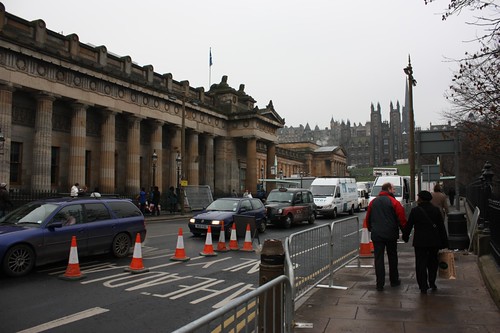

I usually try to hold myself to three to five images a post, but I'm indulging myself for the sake of narrative.
Dec 28th:
Our afternoon was mostly taken up in the the British Library.

I would have loved to have shown you pictures of the "National Treasures" exhibit, which included jotted down Beatles lyrics, a Gutenberg Bible, the Magna Carta, and Jane Austen's writing desk; or the provocative "Taking Liberties" exhibit, which showed interesting British historical documents and the context in which they led to modern civil rights, but the British Library didn't allow the taking of photographs :(. Suffice it to say that it was all pretty amazing.
I did snap this shot of The King's Library, which formed the original core of the British Library, and is still apparently expected to be held separate under the terms of the original donation. I wish I'd had a fish-eye lens, because it's much much bigger than this.

This is an iconic sight in the London Underground -- mind the gap!

We went to see a burlesque Sunday night -- La Clique. It was very, very gay. A good time was had by all.
Dec 29th:
Our last full day in London. I had trouble sleeping, but we hit the ground running and spent the day seeing the sights. This was really the first non-holiday weekday of our trip, so we got to see the city in more of its natural state.
First off: Trafalgar Square. I will spare you most of my pictures of statues and fountains.

Next up: we took a "Duck Tour." World War II amphibious landing craft/troop carriers have been repurposed into tour vehicles. Half of the tour was on the streets of London, and the other half was on the River Thames. Our tour guide was replete with bad jokes, and it was a cheesily awesome good time.
Passing another "Duck" on the river:

House of Parliament and Big Ben:

After lunch, we headed over to the Tower of London. On our way, we passed this odd church archway on Seething Lane:

This is the entryway to the Tower. While it's not in this picture, I found it interesting that the gatehouse to the tower was where the security folks were doing bag checks and checking tickets.

The actual Tower was somewhat disappointing, because it was jammed full of people, and the exhibits were somewhat lackluster in providing information and context. Still, the architecture was fascinating, at least partially because it covered so many different eras within a very small amount of acreage.
I found "The Line of Kings" to be impressive:

And this elaborate arrangement of guns in the royal armoury:

We passed on waiting in line to see the Crown Jewels, though. This picture shows part of the incredibly long line, and also some of the architectural whiplash:

This picture has three interesting things in it. First, a tower raven (in the left). Second, a really old-ass wall. Third, a representative queue of people waiting to get into one of the many tiny tower exhibits.

Here's a close-up of that same raven from the last picture:

Some more architectural whiplash -- it's the London Gherkin in the background!

And here's Tower Bridge and the oddly shaped London City Hall in one shot:

Finally, Tower Bridge at night:

From the Tower of London, we headed to Newham to catch a panto. However, the guide we used steered us wrong, and this one completely failed to have any of the sly subversive humor we were promised. Instead, it was a pretty straight up kid's show. We left after the intermission and spent a quiet evening in the hotel room.
And this morning we're on a train to Edinburgh! More on that in the next post.
Dec 27th: The British Museum.
Our hotel is just around the corner from the British Museum, which is quite an impressive edifice. The interior courtyard gave me a uniquely 21st century bit of deja vu, because I'd seen it before -- in Hellgate: London (note: this is the only part of London I've actually placed from this game). I remember quite distinctly battling some evil yet nondescript creature up and down the stairs that encircle the reading room in the center of the courtyard.

Our first stop was the Egyptian exhibit. As we wandered around, we overheard a gentleman translating the hieroglyphs to his companion. He noticed our interest, and began walking us through some of the basic details of the offering formula featured on the piece we were observing:

We also particularly enjoyed this statue of Ishtar as war goddess:

The drinking horns, and the room of Viking stuff they were contained in, got The Immigrant Song irrevocably stuck in our head:

Possibly the most depressing aspect of the museum was the exhibit of Parthenon statues:

The tone was oddly defensive -- "hey, if we hadn't bought these statues off of a dissolute English lord who picked up their pieces out of the rubble of wars and explosions, I mean, heck, they'd be destroyed by now!" Which, while probably true, didn't make it feel any less like we were viewing the corpse of the Parthenon, laid out on the operating table for us to view.
I'm not entirely sure why this exhibit in particular felt worse than the others in this regard. I think it might have been the sad history of the Parthenon -- it was used as an ammo dump in a 17th century war, and a shell lit off the gunpowder stored inside, which did much of the damage to the structure. It might have been the horrible shape most of the statuary was in, compared to the other pieces on display.
For me, though, it was seeing these statues that are meant to loom over us, sitting stacked one next to the other at eye level, battered and beaten. It's not how I pictured the place. In a way, the Carnegie's display of plasters of these ancient statues had more of a sense of the grand scope I expected.
Still, that hall aside, we found the British Museum overwhelming and awe-inspiring. Our feet hurt, but our heads are full. Also, we took high tea in the museum's cafe, and that was both tasty and delicious.
Dec 24th: We arrived, got settled in. Walked around the neighborhood a bit. Took a lot of jet-lag naps.
Dec 25th: Almost adjusted to new time zone. Had a delicious Turkey dinner at a local restaurant, which was totally ruined by incredibly rude waitstaff. I did not get my Christmas Pudding :(.
Settled in for evening of BBC, including Blackadder's Christmas Carol, Wallace & Gromit: A Matter of Loaf & Death (new!!!), and an amusing Black Adder documentary. Missed the new Doctor Who Christmas special due to a tragic misreading of the BBC website, so have been watching it fits & starts on the awful BBC iPlayer service, which goes to great lengths to be hostile to my efforts to let the damn thing queue up over my slow Internet connection.
Overall, a very nice, relaxed Christmas, despite minor annoyances.
Dec 26th: We set out!
First we went to the London Eye, which is a bizarrely large millennial ferris wheel situated in downtown London:

We obtained tickets, and saw London from a bird's eye view as part of a 30 minute single rotation around the wheel. Between the lateness of the year and the northernness of London, the light was already fading, but I got some bizarrely Blade Runner-esque vistas:

Next, we took a cab over to the rebuild Globe Theatre, which is pretty freaking awesome:


The original Globe burnt down, so this one was rebuilt in the late 20th century to be as close to the original conditions as possible. We took the tour, which was awesome. Our crusty, feisty guide had all kinds of awesome stories about the place:

We now totally want to come back in the summer when they're actually doing a play.
Finally, we booked it over to the West End, where we had tickets for Avenue Q tonight. Sadly, the Noel Coward Theatre is designed for very small people with very short legs, but we still had a blast actually finally seeing the musical, as opposed to just hearing the soundtrack as much as we can stand.
Addendum to my previous post:
I also want to point out that Rock Band gets this -- but Guitar Hero does not. RB makes it super easy to use all of your downloaded content ("stuff") with RB2. It also works with pretty much any instrument controller. GH doesn't work with RB controllers -- on purpose -- and the GH: Aerosmith expansion didn't work with any GH3 downloadable content. Also, RB2 very cleverly made it easy to re-create your RB1 characters, although if they'd really been on top of it they would have included character import from RB1. Guitar Hero 4: World Tour wants very hard to win on features alone, and I will admit it's a compelling list of features. But... I already have the RB1 instruments, and the RB1 songs, and a bunch of songs I bought. I don't think the slidey touchpad frets are going to be enough to justify having to buy all new stuff. Did I mention I also hate to move?
There are interesting comparisons to be drawn between online gaming platforms and operating systems. I'm going to define OGPs fairly vaguely -- Warcraft is one, so is XBox Live, so is Steam -- in that they allow you to play games with other people, provide community features (messaging, achievement comparison), and give you some kind of game to actually play.
These OGPs represent a kind of "stickiness" that keeps you coming back to the game or games supported by those platforms. If given the choice between a game that's out for PS3 or XBox 360, I'll buy the Xbox game even though I own both platforms. Why? I can see my Live buddies if I'm playing the XBox game. You end up investing in your online experience. In Warcraft, I've spent a lot of time developing my library of applications (characters, addons), and I have a lot of interest in maintaining interoperability with others (the social groups I've developed to play games with).
There's even now a Bejeweled that runs inside of Warcraft. The next major upgrade will include in-game calendaring on top of the pre-existing mail system. The todo list -- quests, if you will -- is also getting a major beefing up in the form of new achievements, XBox Live-style. I've long contended that Warcraft is the most interesting online productivity suite out there, if you're willing to accept that killing giant dragons is an interesting group productivity activity.
And why not, really? So much of our 21st century life is based around the production of things that have no physical basis. Yes, the software I develop gets dumped onto a CD or DVD every so often, but that's an artifact of distribution -- and since I don't work on distribution, there's nothing tangible, really, that I craft with my fingers. (And iPhone apps are purely virtual!) What remains interesting is not the physical or virtual mementoes of the process, but the act of doing, and the social constructions that remain from that act. In this, online gaming now resembles blogging, in that the community and the memetic constructions are what remain lasting.
So what's a new game to do in this space? One could liken the release of Warcraft to the release of Windows 95 -- a social gaming space that finally broke through to the masses. (I'd say the same for Live and Steam but really... nothing like them existed before for the markets they address.) Before Warcraft, MMOs existed -- the DOS of DikuMUDs, the Windows 3.1 of Everquest -- but they had not yet shattered that accessibility and usability barrier to really catch on. And since Warcraft, there have been a number of attempts to learn from and inherit the space that Warcraft owns, but none have really been successful. I've tried several of them -- some, like Lord of the Rings Online and the most recent, Warhammer Online, are fairly faithful extend & embrace copies of Warcraft. So why do they not have the same traction?
It's that stickiness. When Age of Conan came out, the die hard neophiles jumped to it -- in the millions. Funcom's stock price rocketed. But then those same players abandoned the game in droves. Why? The social space wasn't as rich. The game itself wasn't as mature and stable. And, frankly, you didn't have your stuff. Why don't people jump from one OS to another purely based on features? The reason I hear most often is, "I'd have to re-buy (or re-acquire) all of my applications." Switching online gaming platforms is getting to the same place -- you want to play the one your friends play. You want to play the one where your stuff is.
I've been messing around some with Warhammer Online (and did the same with Lord of the Rings Online). Both games clearly very carefully learned the UI lessons of Warcraft. Jumping into both games feels very comfortable for an experienced player, and they've clearly taken care to make the experience pleasant for the new player as well. But neither stuck with me because I have great affection for my communities and my little avatars.
What's the solution for these brave new upstarts then? To be honest, I'm surprised nobody's done it yet. It's the same as the solution for, say, a plucky presentation software upstart that's challenging the dominant paradigm. You provide the ability to work with your old stuff, and another compelling new features to make you feel like you're mistreating your old stuff to work with the old app. Blizzard's already put the foot in the door already -- all of your WoW characters can be examined (in XML format, no less!) via the armory.
Mark my words -- some brave asshole will finally put two and two together and make a WoW character importer for their new game. And it'll work terribly. And their will be lawsuits. But then the idea will be out there. And then, eventually, we'll see avatar portability and a persistent, interoperable virtual stuff space. I give it ten years. After all, somebody you know is probably raiding tonight. These virtual spaces are here to stay.

Somehow, in my characters' elaborate backstories, they all end up to be family members. Here, we see Cynnosure, holy warrior, posing with her younger sister Checkers, who has recently embraced the light. These two holy warriors are nothing if not pragmatic -- Cynnosure saw Checkers' time spent studying the shadow as only sensible.

Cynnthia & Felicia have a somewhat more complicated relationship, as they had very different reactions to the death of their parents to the Scourge. Cynnthia chose to confront her anger head on, with a sword. Felicia has adopted the dark magics that brought the undead into existence -- she says, to better combat them. Neither really understands or respects the other's decision, but they still try to make it work.

Cynndethiel Stormwalker had a sister, once. Dechesel was lost in the fighting when the Burning Legion invaded Ashenvale, and was presumed dead.
Imagine, then, Cynne's surprise when the Knights of the Ebon Hold renounced the Scourge - and Dechs was among the undead Death Knights now returning to the Alliance, and renewing old ties.
Marty requested that I revisit my Mass Effect post. Sadly, I must reveal that my XBox 360 was stolen back in January, and I have not yet gotten around to replacing it. We were watching TV one night, and I looked down, and the 360 and the PS3 were just... not there. To which my only response was, "hey, didn't I used to have a 360?"
I'll probably be replacing the 360 soon (one of my brothers is moving to Austin, and we have plans to found a Rock Band, if you know what I mean), but my jumping back into Mass Effect will almost certainly be dependent on the PC version being released. Still, I can comment on what more of the game I played between my last post, and the disappearance of my save game. (Oddly enough, that's what I was most upset about -- they stole my save game!)
Bioware has this structure to their games. There's
* the initial story hub area, which you must complete before you can unlock the "freeform" part
* the "freeform" part, which typically consists of three less-well fleshed out sections than the part that initially sucked you in
* a bizarre final sequence that you can identify because they've taken away your ship.
I am always a sucker for the first part. It's where they do their best work.
In Mass Effect, they tried to spice up the relatively thin pickings in the freeform part by adding some collection games. Being full of OCD, this initially satisfied me. Then I got irritated by the lack of in-game interface for keeping track of the collection games. I was keeping a pen & paper list of which systems I'd explored so far, and it was driving me nuts. When I revisit the game, I will probably skip most of the optional stuff, and just dig through the story.
That being said, I was still digging on the combat, the writing, and the visual look of the universe at the point I stopped playing. I just stopped enjoying the filler where I drive my ATV around the restricted subset of the planet to find the macguffins.
Marty also mentions the whole good vs evil problem. I didn't mess with the "bad" choices much in the game, but I guess I had more of an impression that -- like in Jade Empire -- that evil wasn't evil so much, as a philosophy of, let's say, personally-oriented goals. The good/evil stuff is just a way to hang unique snowflakes on the infinite hallway, however. The story isn't fundamentally going to change. Sure, the final cutscene may vary (see Bioshock), but it's a narrative trick to give you the feeling of agency in a story that cannot possibly be customized for you.
The long awaited Mass Effect came out this week. It's BioWare's second take after Jade Empire at doing their own IP and... they did a pretty darn nice job.
If you've played other BioWare games, the biggest shift here (as in all of their games) is the combat system, which is always the place where a heavily story & converstaion based RPG can fall down. So let's talk about it first. The combat here is a little impenetrable at first. They borrow from squad-based FPS games this time instead of from the Virtua Fighter class of games. You shoot at people, and can issue orders to your squad, and it seems OK until all of a sudden some dude takes out one of your guys instantly and you don't really understand why. It took me a little bit to get that I did actually want to use cover -- and have my squad use cover -- and the game waited a little too long to explain that I could pause the game with one of the shoulder pads and assign special commands to each person. Once I figured out I could overkill somebody with three special moves at once, combat got a little more interesting.
That being said, in three hours of gameplay, only 30-40 minutes of it has been combat so far, so I also don't really feel like I've gotten a chance to practice the combat much. I kind of expect that to change once I get past the inevitable "that first well developed planet BioWare does before they give you a ship" model. The manual sort of leads me to believe that rather than the normal KOTOR one planet -> three or four planets -> finale planet model, I'm going to be able to explore tons of random planets ala Wind Waker or Oblivion, and get completely sidetracked on alternate missions if I don't follow the main story mission. We'll see.
Next up: presentation. Wow. OK, blah blah, 360 graphics are pretty. But more importantly, the visual design of the game is just incredible. That part of me that wants to nerd out in a cross-breed universe of Star Trek and Star Wars, without having to get bogged down in the decades of continuity and staleness of either, is totally digging this new space BioWare has dreamed up for me. The ship design, the alien design, the enormous space stations, the backstory -- I'm just loving all of it so far.
The conversation system is the real revelation, and it's not because it's new in any way -- it's because they've done some important refinements on what they've been doing all along.
No spoilers in this example. There was a quest/conversation I recently hit that -- well, a man was asking after his wife. He needed some help in talking to another person about this. When talking to both parties, I was given my "charm" option, and in both cases, I could use it for something that seemed like a good and right thing to do -- but the right thing to do totally depended on what my character actually thought was the greater good. So I ended up convincing one of these two that the other was right -- and I actually teared up a little. Yes, in some small subtle way, BioWare finally nailed the essence of small-scale emotional storytelling. I'm not saying the whole game is a masterpiece of storytelling, but you can tell they've been doing this for a while and they're pretty good at it.
The game's not perfect. Combat and character leveling are still somewhat opaque to me. Targeting is a little twitchy. The minimap seems to be kind of useless. But I really like what I've seen so far, and I'm eager to see what the game is like once it opens up and I'm not just exploring a space station, huge and well developed as that space station might be.
Carrie & I, of late, have been spending our Thursday and Friday evenings running what is known as "a raid." Yes, we break open a bottle of wine, order a pizza, and settle in with eight buddies that we've mostly never seen before. And then, we venture into the mysterious tower of Karazhan, in World of Warcraft.
"Kara," as the kids call it, is the centerpiece of this most recent WoW expansion. It's not the toughest thing going, by any means, but it's the first raiding-quality dungeon that Blizzard aimed at smaller guilds. Originally, the game had stuff to do with five people... or stuff to do with forty people. There wasn't a lot of middle ground. So, when at some point you realized you'd exceeded the challenge of the five person stuff, you had to make a huge organizational jump in order continue advancing your character and gets the shiny loots.
There were a few dungeons aimed at 10-15 people, but to really find the interesting boss fights and newer, better rewards, it was 40 or the highway. And forty folks makes it kind of inevitable that the discourse level is going to sink down to the daring wit of "your mom!"
Karazhan fixed a lot of this for smaller guild. We're a pretty active guild, but we also have folks with diverse interests and skill levels, not to mention scheduling conflicts. So, a really big dungeon aimed at ten skilled players? Gravy, baby.
When we started on this endeavor in May, we had interest, but we were kind of lacking in gear and experience. So... we spent a month or two hitting our heads against the first few bosses, feeling frustrated, wondering when the tide would turn. And, little by little, it did. Carrie grokked the roster organizing issues needed to ensure we'd have a good shot against various parts of the dungeon. I fussed with our lineup and folks roles until our tanking and healing were a nice strong base to support our damage-dealers with. We learned strategies. We educated folks on gameplay. And....
Well, this week, I took a couple of movies to demonstrate our progress.
First off, Moroes, the second boss in the dungeon (and the first one you can't skip).
Moroes has four guys helping him. You have to deal with those four guys somehow, by controlling them or killing them, before you can work on the actual boss. Normally we deal with this by bringing plenty of crowd control, and dragging these other guys out of the way. But we've been noticing our main tank is pretty tough lately -- so this is us using raw brute force to blow out this fight:
Sorry, my camera's pulled back pretty far in that one -- first try at this sort of thing.
Second is the guy who lives at the top of the dungeon. We killed him the first time last week. This week, Chris & I both shot video of the fight, and I messed around with the new iMovie to mix it together:
So, if you find yourself wondering what the heck I do in my leisure time... now you know.
I messed with it perhaps too much yesterday -- stayed up pretty late :).
What astonishes me is how fluid the interface is. The gesture language of flicks and pinches and jabs just really works. I keep expecting that I need to use my fingernail to try to pretend I'm using a stylus, but if I just jab with my big ole fingertip, it's way more accurate. When you're going between tabs in Safari, you flick around between them, and the ones out of your focus fade into focus as you slide them into view. It's a really subtle and great UI feedback.
At first I was stymied by the lack of setting a "home" for the map application. Then I realized how incredibly fucking fast it was to start from the USA level and get to my street, and once I did that, searches were relative to that. Wow.
The keyboard is not perfect, but it's impressive how good it is. I wouldn't want to take notes on this thing, but I would happily fuss around looking up shit on google all day long on it. And that's fine with me.
I managed to crash Safari once, and it just smoothly went back to the menu screen, and when I tapped on Safari again, it came right back up and reloaded the page. The next time I synced, it asked if it was OK to send an error report to Apple. Nice.
This shouldn't surprise me, but the built-in VPN support just worked.
It's just compulsively usable. The whole thing. The little flickable toggle buttons, the ability to just dig in by zooming in -- oh my god, it's the future, and it's only a wee bit taller than my current iPod.
I'm in Geek Love. Go get one, if you can. Now. I say this purely as a consumer who stood in line for two and a half hours -- so worth it.
While I will be getting a second iPhone in a month (which will be Carrie's), my enthusiasm could not be contained and I decided to go get in a line today in order to obtain my long-awaited phone. I confess, I have been eager for a phone from Apple for years now -- I have always hated the phone experience, while at the same time feeling the phone is the only gadget I can realistically carry around at all times (as much as I love my teeny weenie camera). So, the idea of a phone with a user interface that didn't, well, completely suck is undeniably appealing.
I started to go off on a tangent about phones that suck, but that's not what we're here for today. Instead, let's talk about the iPhone buying experience. In a word: amazing.
I thought about going to an AT&T store, as had been hinted broadly was the right move, but instead, I decided to head to The Domain's Apple store here in north Austin. I figured if the line was impossible, I'd change gears, but the idea of buying the phone in an actual Apple store was too compelling. I got there at 4 -- two hours before they were to re-open. I figured that was my max time I was willing to wait, and if it was too nuts, well, at worst I'd order one online.
The line was long when I got there, but not crazy long. I reckon I was #200 or so in the line. The Domain is an outdoor mall, but with plenty of shade, so it was nice to be in this strange outdoor world for a while. It was hot and humid, but there was a nice breeze, and I ran down my poor old RAZR's battery talking to my Mom for an hour or so. After that, I listened to my current audiobook and crowd watched. It was a pretty fully line -- by the time the store opened at 6, I was probably at the 2/3 mark. By the time I bought my phone, the line was back to where it was when I started. So... I suspect we're going to report good sales numbers today :).
Everyone was polite and enthusiastic, and there was a definite energy to the crowd. Once the store opened, the line moved pretty fast -- it probably took 30 minutes for me to actually get in the door, so that was two and a half hours spent total in wait. Inside, they'd set up like they do for the holiday iPod sales, with a very fast path for people who just wanted iPhones. Once you got an iPhone, you were welcome to keep shopping and make a second purchase if you chose. They had different queues for those folks buying 4Gs, 8Gs, and 1 or 2. There were still quite a few stacked up even when I got mine, so I suspect first-day demand will be well met, unlike, say, the Wii (I finally obtained a Wii two weeks ago through a lucky accident, even though it's been out for half a year).
The actual phone is super slick looking -- just a little taller than an iPod, but about the same width. The screen is bright and sharp. The web browsing is all I've tried so far, but it seems to work great -- the double click enlarging is very fast and smooth, and seems to use the web layout itself to inform the resizing. Yes, folks, it's the VERY FIRST EVER use of the semantic web. I already posted my first twitter from the phone -- using the web browser, not SMS. Woo!
And now that I've finished synching and setting it up, I'm gonna go mess with it. I'm pretty stoked!
There's footage of the tech demo of the coulda-been Fallout 3 as Black Isle would have done it. Black Isle, of course, was the Interplay RPG division responsible for Fallout, and Fallout 2, which were both brilliant games. It was also responsible for Fallout Tactics: Brotherhood of Steel, which was... not a brilliant game.
But then Interplay lost their way, and the next game in the Fallout franchise was one of those crappy "RPG-lite" console games, that pretty much missed the whole point of turn-based tactics and well-written cynical humor. And then Interplay/Black Isle pretty much self destructed. And we all figured that was that.
BUT WAIT! We come to find out that Bethesda Softworks, who was responsible for the equally -- if differently -- brilliant Daggerfall, Morrowind, and Oblivion have acquired the Fallout license. Which has caused a great wailing and gnashing of teeth among the "Fallout faithful," about how THIS WILL RUIN EVERYTHING. But for the Fallout fanboys out there, especially those posting about how watching this video brought a "tear to their eyes," let's be clear: this video demonstrated that Black Isle's vision for Fallout 3 was to do EXACTLY THE SAME THING OVER AGAIN, but this time with crappy 3D models instead of 2D models.
Ahem. Sorry about the caps, there. Talking about fanboys brings out the mouthbreather in me, too. But this video clearly demonstrated to me that there was nothing we were missing from yet another Black Isle run at this. In fact, having played Neverwinter Nights 2 from Obsidian, the guys who -- if they'd kept their jobs at Interplay -- would have been doing Fallout 3, makes it abundantly clear that the turn-based CRPG is currently in the hands of a fascistic and dogmatic Cromwellian regime who are so tearfully holding on to the past that they have no vision for the future. So thank all the powers that be, I say, that Fallout 3 is not going to sully the memory of a great game, and that Bethsoft will have the guts to take the franchise somewhere different, even if that somewhere different sucks.
As we have the week off, I have been taking the opportunity to finish off some of the games I have bought recently.
Dark Messiah of Might Magic
Dark Messiah is branded as a Might & Magic game, but this doesn't really mean much more than "it's a fantasy FPS." And that's fine with me. In face, my experiences with the last several M&M RPGs were so irritating that I assumed this game was also going to be a waste of my time, until I downloaded the demo. Go ahead. Go download the demo. I'll wait for you.
People have had mixed reactions to this game, but I'll say this -- if you loved the demo, you'll love the game. Because the demo showcases why this game is incredible: a visually amazing fantasy world in which you get to burninate, stab, freeze, and kick people -- the latter preferably leading to any of the former, unless by happy accident your foe has his back to the abyss. Yes, yes, the story is trite and predictable. But we're not here for the story. We're here because Dark Messiah absolutely nails sword & sorcery combat in a first person setting, and dresses it up with Half Life 2-quality visuals. The game has a limited RPG aspect -- think Deus Ex. As you proceed, you can tweak your character along the brute warrior, archer, assassin, or spellcaster paths, or any combination of same which works for you. Combat is great -- while you can just whittle down an opponent's health, you can also create opportunities to end the fight decisively in your favor. Foe knocked to the ground? Execute a coup de grace. Worked him around to merrily blazing open fire? Kick that sucker in. Or use your spells to freeze him, lure him into a trap, or just charm him into working for you. Stealth kills also just... feel right. And the rope bow from Thief makes an appearance (as does another homage to that great series -- a master thief's outfit embroidered with a G, found in a room that to me looked suspiciously like a certain character's homebase in Thief 3).
The visuals will tax your machine, but they sure are purty. With Valve's high dynamic range support turned on, the contrast in light and shadows as you roam through murky subterranean tunnels approaches a virtuoso quality. Your fancy graphics card's fancy shaders will work overtime to put glossy sheens and gritty surfaces on everything you pass. Put it this way -- forget Oblivion.
In fact, "forget Oblivion" in general characterized my feelings about this game. I spent a lot of time traveling Tamriel, and enjoyed it, but it's a very shallow traversal of a lot of land. Here, the skills to choose from are extremely tightly focused, and -- since it's an FPS, not an RPG -- everything takes place along a highly designed infinite corridor. You won't be wandering the land looking for quests. You'll never vendor things to a merchant (no, seriously, you won't, so don't be a dumbass like me and hold on to every weapon you find). You will travel from Startington to Endville in a direct line, burninate all foes that stand in your way.
The game isn't perfect by any stretch, but it should be of no surprise to my regular readers that I am a sucker for the flawed gem. As mentioned, the story can be seen coming a mile away. "What, character M is EVIL? SURELY YOU JEST." They call the final boss sequence the "epilogue." Poison will keep ticking until your health hits 5 no matter how much you heal yourself. You can really screw yourself in the midgame if you haven't focused on a particular specialty -- I tried to straddle magic and combat, and wasn't good enough at either once I hit spiderville, so I burned through a lot of potions until I could fix that.
Gears of War
So, there I was, already impressed by the visual splendor of Dark Messiah. I kept hearing good things about this other game, Gears of War, but I'm thinking "yeah, yeah, the 360 has been OK and all, but I'll believe it can outdo my badass PC when I see it."
Yeah, well, now I've seen it.
Gears of War succeeds from a gameplay perspective, from a visual perspective, and -- to the extent it needs to -- a storytelling perspective. We'll deal with those in reverse order. The story is mostly straight Hollywood blockbuster schlock, including at least one mid-game revelation that's straight out of cheeseball comicbooktown. But that's ok, because the characters have just enough personality to -- as XPlay comments -- be interesting without being caricatures (loosely quoted). The banter between your squadmates provides just enough glue to keep you moving forward as you are catapulted from brilliant combat sequence to brilliant combat sequence in the midst of dilapidated visual glory.
The visuals truly are impressive. I do share psu's concern about the muted color palette, but the shiny! The gritty! The pockmarked detail on your Gears and on the environment add just enough immersiveness to really wrap the whole package together. More importantly, blur is used without feeling like a gimmick. When you spin the camera fast, or when you focus in on something, depth of field is actually used to effectively align attention, rather than to show off that they can do it. The coolest bit is the way that the camera foreshortens as you change what you're doing. The field of view actually changes cinematically as you pop in and out of cover, or barrel into a roadie run. It's subtle, but it's effective. Finally, whenever there's something you really should see, you can jab the Y button and your camera swivels to the current point of interest. It's just well done.
But that's all sideshow. We're here for the inner loop. And the inner loop is glorious. Other games have attempted to make seeking cover an essential part of gameplay, but Gears of War really makes it feel integral and strategic. Taking a play from the "keep it simple but deep" playbook, the A button is your all-purpose context sensitive "get me into cover" button and it works great. Getting nailed? Push towards a block and jab A -- your guy will paste himself against that brick like nobody's business. In cover and need to move? Angle towards another piece of cover and jab X -- you'll do the appropriate cool SWAT turn or barrel roll or whatever. It feels a little funny at first, but it soon becomes second nature.
Once you're in cover, the game becomes strategic. Keep an eye on those opponents as they move forward -- lay down some covering fire! Pop over long enough to take a guy out, but don't stay out too long. Lob a grendade! Call in a satellite strike! You have a simple set of tools, but their use is rewarding. I've played the game a lot these last few days, because getting to the next firefight and then getting through it remains a pleasure that comes in delicious bite-size chunks. Plus, at any time you can call in a pal to join your single-player game and make it multi-player. I shanghaid psu into helping me out with about half of Act 3, and it was a blast.
Time for another infrequent bout of epeening, as I take a moment to crow about our virtual victories in the fictional (yet small-country-sized*) World of Warcraft.
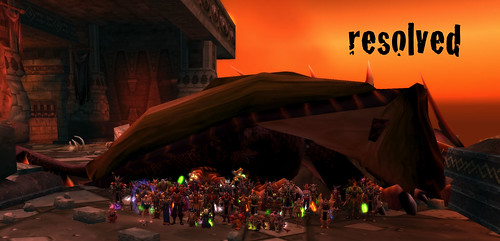
I participated in a rare Sunday raid last night, since our Friday night raid had left us this close to defeating Nefarian, brother of Onyxia, leader of the Black Dragonflight. No more will he and his sister manipulate the Alliance! Well, until tomorrow, when the instance resets and everyone gets on the ride again.
The "end game" 40-man content in WoW goes like this: Molten Core, Blackwing Lair, The Temple of Ahn'Qiraj, and Naxxramas. It's fair to say that the 40-man organizational requirement keeps most folks out of Molten Core, so even that part of the progression has a certain mystical awe to many WoW players. Nefarian is the end boss of Blackwing Lair, the second dungeon, and the first one to feature really interestingly designed boss fights that require a good deal of coordination and adaptability. We'd been stuck about halfway through the dungeon for several months, but in the past month and a half we got past our roadblock and have been making steady progress through the rest. This was our second serious try at Nefarian, and I'm proud to say we pulled it together and downed him after a handful of attempts.
This is a pretty big achievement -- yes, there are some pretty kickass hardcore guilds that are well into the most cutting edge of content, but completing the second major dungeon puts us in a pretty small class of folks. It was a pretty cool feeling, made all the sweeter by the discovery of a Stormrage Chestguard among the vile dragon's effects -- an armor upgrade I'd been extremely covetous of for my druid. (I'd already had the matching moose hat, so one more piece, and I'll be an extremely happy camper.)
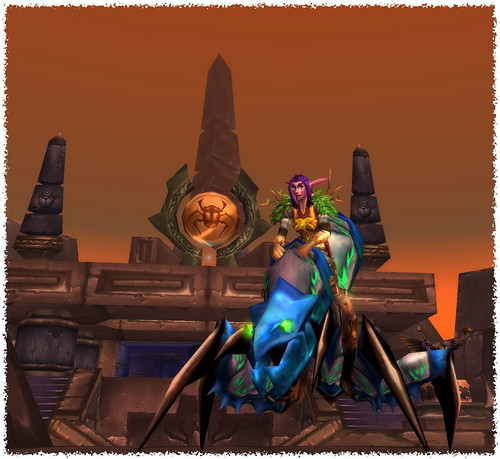
Since we downed Nefarian with some time left in our scheduled 3 hour raid, we decided to proceed to the Temple of Ahn'Qiraj, or "AQ40," as it is affectionately known amongst the "we hate to type things out" set. AQ40's mythology revolves around a mishmash of bug-monsters and Egyptian iconography (giant Anubis critters feature prominently). In the picture above, you see my druid about to descend into the mysterious temple of these creatures. But what, you say, is that mysterious mount she rides on? It turns out that -- once you enter the temple -- you can't ride your normal mount. (In Cynne's case, a giant blue panther. Just roll with it.) Maybe it can't take the confined spaces -- who knows. But, as you work your way towards the first boss, new bug mounts (which you can only use inside of AQ40, and which look nothing at all like Starship Troopers bug things) drop. I think they look pretty cool -- a Starcraft zergling you can ride around. I finally got mine last night.
So... yeah. I play because it's fun, and to see new stuff, and to see what we can do. But I won't pretend I don't enjoy nights full of delicious and delightful loot. Woot for loot!
* At 7 million active subscribers, the game currently ranks as being in the top 40 population centers of the world, and among the top 100 countries in 2006. That's freaky, man. Freaky.
So, in the throes of my Star Wars Hating, I wrote:
Starting and ending combat is irritating and distracting. Starting requires rebuffing your 20 second long buffs EVERY TIME. Ending requires finding the body to click on in order to loot. Why does a Jedi or Sith Master care about loot anyway? I think this game would have been better served leaving commerce out altogether. Maybe you get reputation (good or bad) for doing stuff, and can use that to improve your stuffs.
After some further IM ranting, psu took the opportunity to rant about loot in general. I found this comment particularly interesting, though:
Ugh, the surprise of finding something nifty in a chest or barrel is half the fun of playing RPGs for me. This has nothing to do with realism, it's just that I love the exploration aspects.
So, the question in my mind is -- why do I enjoy looting in WoW, but not in KOTOR2? In both cases, there's irritating inventory management, and random crap that mostly I can't use except to turn into money. Why not cut out the middleman and get right to the "gimme money" part?
I think that fundamentally, it comes down to the inner loop and the outer loop of the game mechanic. I'm going to say the inner loop is what psu calls the "30 seconds of fun." It's the repetitive mini-game that makes up the core of the experience. The outer loop is the meta-game -- it's how the inner loop's rewards are translated into long term character improvement.
The inner loop is the most important -- it is, essentially, the game. How much of your inner loop is spent doing the fun stuff? How is it distributed between buffs/combat/looting/resting for next fight? How hard is it to accomplish any of these stages? Am I clicking too many times per stage?
My objection to KOTOR2 was that the inner loop was a pain -- you had to click excessively to buff and loot. Depending on how you set up your character, downtime could be minimal -- but the healing to reduce downtime interfered with the buff portion of the next combat, because healing and buffing used the same shortcut key. Combat consisted of allowing the auto-attack to go off, or using one of several special abilities, all of which are really oriented around attacking guys who are weaker than you, because D20's combat system is kind of stupid. Looting was also irritating, because the loot didn't spawn until a few seconds after combat, and required clicking on a small portion of the screen (not necessarily the same place you had been clicking for combat), then clicking in some other portion of the screen to accept the loot.
Contrast this to WoW: most buffs remain around for 30 minutes, not 20 seconds. The grunt part of combat -- swinging your sword -- is automatic, leaving you to worry about strategic decisions about what combat abilities you will use. You might argue this is the same as the KOTOR case, except that the combat abilities here actually affect something more than your critical strike chance. Looting, to be fair, also requires finding a smaller area to click on -- the fallen corpse -- but you can shift-click to loot everything in one swoop. So, the high level details are the same, but the excessive clicks and mouse motion have been optimized out of the inner loop.
(Side note on buffs: there is one class in WoW -- the Paladin -- which has shorter term buffs. What's interesting, though, is that the casting of buffs is actual part of the combat phase, because you can "judge" these buffs onto enemies, turning your buffs into your enemy's debuffs. So, in this one case, the act of buffing is integral part of the combat cycle, as opposed to an irritating chore.)
So, what to do with that loot you get? Well, here's where we get into the outer loop -- what do you do with the spoils of the inner loop.
In KOTOR, the loot is irritating because there's (A) so goddamned much of it, and (B) you will -- with the exception of maybe 3 sequences -- NEVER EVER USE ANY OF IT. A lot of the loot is blasters and mines and grenades and... combat stuff that Jedi never use. And let's be clear -- the Jedi are so over-powered compared to any other class in this game, that unlike KOTOR1, it's actually possible to turn most if not all of your party members from blaster-wielding thugs INTO Jedi. So... most of the loot is pointless. On top of that, there's no cost to keeping all of that loot, because you have no inventory restrictions. So it starts to pile up. But surely, you say, you would sell it so you could get AWESOME GEAR from merchants! The problem is that there is no awesome gear from merchants -- it's more of this blaster/grenade/mine crap. There's the occasional Jedi robe, but nothing you won't see drop out of some... spider or bounty hunter.
So. No inventory restrictions. No reason to sell loot, because no reason to spend money. Why do I care so much, you ask -- it sounds like I just won't ever look at my inventory. Well, that's the problem right there. First off, I'm taking valuable time out of my inner loop to populate this inventory -- but I don't care about it. Secondly, every so often I do care about it -- some upgrade for my armor drops, or some miscellaneous item which I don't know much about, and might want to use. But, because inventory is chock-full of crap that I never bothered to sell, because -- for twelve hours straight -- there was no game mechanic that told me selling was a worthwhile endeavor to bother with, I've pack-ratted up 400 blasters because I might need one someday. And now I can't find the +10 shoulder pads of ninjosity, because it's hidden in a field of crap.
Obviously, yes, if I did my chores and was a good boy, this "wouldn't be a problem," but it turns out I'm playing this game to have fun, not to do my chores.
So again, let's contrast with WoW. What's interesting in WoW is that all that crap you'll never use? It's clearly highlighted as such. Items come in rarity classes -- grey, white, green, blue, purple -- and grey stuff is explicitly put in the game for you to turn into cash. No player will ever want it, but vendors will pay absurd amounts of money for it. White stuff is similar, except that player-craftable items might use it. Green and better drop infrequently, and we'll discuss them later.
So you've spent 30 minutes killing bugbears and your bags are getting full of grey and white stuff. Here's where another interesting part of the outer loop comes in -- similar monsters drop similar kinds of grey and white stuff, and the stuff stacks to some extent. So the outer loop is actually encouraging you to keep doing what you're doing, because you'll get more efficient use out of your bag space. It means that collecting crap for vendors is no long merely a grind as you populate your bags with mountains of miscellania -- you're actually playing a resource management metagame as you decide how to pursue various quests and still keep your bag space free.
But... what do you do with all that money? After all, in KOTOR2, it's pointless. In WoW, you actually need to acquire a certain amount of in-game cash just to keep playing. Armor wears down, and must be repaired. Fast travel costs money (although hoofing it is always free). Resources to improve your inner loop -- bigger bags, water & food to replenish health & mana -- cost money. Group content requires you to spend money on spell reagents and (for high-end content) protective potions. Once you've acquired some piece of gear you think you'll be using for a while, you might want to spend some bling to get it enchanted to make it even more badass. There's a sense of weight to currency that doesn't exist in KOTOR2.
On top of that, there's the fancy green and better items, which -- in some cases -- even if you can't use, someone else might be able to. So there's a whole economy mini-game based around selling this stuff to other players, either through negotiation or auctioning. Or that you might try to acquire for yourself, rather than spending hours hoping your magic boots might drop. Time spent is turned into money acquired; and money acquired can turn into time not spent. This is in stark contrast to a game where "getting through the levels" is the predominate design philosophy, so money and time are no longer fungible resources.
The short version, for the TLDR crowd: loot needs to not be intrusive in the inner loop (easy looting, stackable loot when you're engaged in the same task so that there's only a cost when you shift gears) and rewarding in the outer loop (money means something and contributes to your character advancement) in order to be a useful game mechanic. Otherwise -- it's just wanking.
So yesterday, my shower wasn't hot -- it was lukewarm. Lukewarm, verging towards tepid in short order. This made me sad, since it was a Saturday, a challenging day to get a plumber to come out and... fix whatever the hell it is.
So, I went back to basics and put the problem off. I accomplished this successfully for several hours, but eventually I figured I should at least look at the hot water heater and make sure it isn't spewing water everywhere. First I stalked around the house, trying to figure out if I heard any water noises, but nuthin'. So I clamber up into the attic, and peer at the thing. No water in the splash pan. No sparks or explosions or banging noises. The heater feels warm to the touch. No gas smell. Burrrrr?
The obvious answer is that the pilot light is out, but my eyes start to glaze over as I read the instructions. Physical maintenance on a house appliance? Dude, that's not how I roll.
This morning's cold shower convinced it was time to at least give it the old college try. Once again, I clamber upstairs. I follow the extremely prominently placed instructions to the letter. And by gum, if I don't relight the pilot light, and totally fail to explode in a Tyler Durdenesque blaze of glory. Fifteen minutes later: HOT WATER.
Hey -- this stuff is easy! Who knew? My world view is shattered.

For the World of Warcraft nerds in my audience -- yes, I finally started raiding a few months back. I resisted it for a long time -- playing with 40 guys seemed a lot more impersonal than playing with 2 or 5. But then we found a like-minded guild of nerds, and discovered we kind of kicked ass at it.
One of the aspects of playing the game is that when you slay the dragon, you get some nice loot to make you smarter, faster, sexier to all the virtual girls (or guys, or antelopes, or what have you). It's random, so you keep going back week after week, hoping the +5 Boots of Kicking Ass will drop this week, and that you will beat out all the other grubby-handed gearhounds who you compete with... I mean, are part of a big happy family with.
I've had, to understate it slightly, extremely good luck. In the past few months, I've upgraded was already a very nice end-game set into a crazy, all-singing, all-dancing set of healing garb. I play an infrequently played class -- a healing class that, to the uninitiated, appears to be a weaker class because it combines aspects of multiple roles. Since it's infrequent, I tend to get the "phat lewtz" (as the kids say) in a more steady stream than the eight hunters that keep showing up to our 40-man extravaganzas. But it's a satisfying class because of that very hybrid nature, and when properly outfitted, my abilities to heroically keep our band of battle-hardened noobs up and about can be terrifying to behold. Well, I got my Tier 2 Antlers of Omniscience a few weeks ago, and last night.... last night I finally got my Epic Oven Mitts Body Wrap of OMGWTFPWNAGE. So yeah. I'm pretty happy. And far too tired.
It's been interesting to see the difference as I upgrade all of this gear. For the more damage oriented roles, the only way to measure progress is to watch your raw damage output climb up the charts as you compare your virtual phagitude to all the other wielders of arcane mysteries out there. It's all pretty relative, because in the end, you're a wheel in the cog of raw damage output to bring down the fiery lord who resides under the earth. Healing's different though -- with healing, if you expend your own reserves too fast, other people start dying. So healing output, mana pool, and resource regeneration all play factors. As you start hitting the crazy end game stuff, fights go from 1-2 minute affairs, to -- I kid you not -- 8 to 20 minute long epic blastfasts. Suddenly regeneration becomes much more interesting than it had been in what, in retrospect, seems like an incredibly short fight. Last night, I realized that I'd gone from "good effort, but easily exhausted" to "what? are we done already?" As we fought our last, desperate, doomed fight, I heard the other healers cry out around me "I'm out of mana," while I kept on trucking.
Yeah, it's all virtual. Yeah, it's a self-contained world. But... we fought a dragon. And now I have Epic Oven Mitt Bodywraps of OMFGWTFPWNAGE. It's a nice way to end the week and start the weekend.
There's a post from Robert Scoble that's been rattling around in my head for almost a month now: Second Life +is+ an OS.
(Rest of the essay behind ye olde jump to keep my RSS feed from spinning out of control.)
When I went in to pick up Katamari, I wandered by the PC aisle, and found the recent advertising hype for the latest Tomb Raider game washing over me in an irresistible wave. The last time I touched a Tomb Raider game was a decade ago -- after having finally gotten on board with this whole crazy "3D card" revolution, I tried out the demo of the first game, and found myself hopelessly lost and confused.
The series has had a strange history -- the notional game is hugely popular, but every recent game has been considered mediocre at best. So, as time has passed, my curiosity has grown as the series has declined. So now, finally, comes an entry that not only is supposed to be good, but is also designed for the so-called next generation of consoles -- how could I resist?
I have nothing to compare against, but so far I'm finding the game quite enjoyable. I'm probably a third of the way through, and I've found the gameplay all I'd hoped it to be. The core of the game is exploration and puzzle solving, and the puzzles have all been suitably satisfying and epic. The platforming elements are entertaining and well done. The scenery is breathtaking -- the most recent level I've played shifts from scaling up a waterfall to scouring the innards of an ancient temple in a suitably cinematic way. The game employs a depth-of-field technique to great effect, and gets little details like water spray right.
The game's not perfect, by any stretch: gunplay is diverting but simplistic, the camera can be frustrating, and the console mechanic of save points is, as always, infuriating. It can be especially infuriating during the occasional motorcycle sequence, sequences which are brutally unforgiving to poor steering. But these faults, while irritating, aren't dealbreakers. Ultimately the game's action movie sensibilities win out over the imperfections -- there's a sense of adrenaline-fueled pacing that pulls you to the next sequence quite effectively.
One last note on the cinema angle: the cutscenes take a page from the Indigo Prophecy school of interactivity. It's not as involved or distracting as in IP, but it hooks right into that same idea of breaking down the empathy wall and making you believe you're a stakeholder in what's fundamentally a canned action scene. It's great.
So, Bethesda (makers of Oblivion), have unveiled for-pay downloadable microcontent for the game. What's interesting is how it has played out: "Swell. Stupid Oblivion Horse Coming To PC" (Kotaku).
Basically, there's a ton of people out there who are very very angry that Bethesda would charge money for new content. Since, as we know, once you buy a piece of software, you are entitled to all follow-on work inspired by that software for ever and all time. This is why developers enjoy releasing software, by the way -- they enjoy entering that period of pure art for arts sake where they simply work on free, open-source versions of software that -- having been sold once -- can never be ethically sold again.
But I digress. What I think is weird about this uproar is that it's over a $2.50 (or $2, depending on if you are an XBox 360 or PC player of the game) piece of content that is essentially a bit of in-game bling. Something that's effectively no different then buying a face plate for your cell phone, or an action figure for a show you like. Or, maybe, a book based on your favorite Joss Whedon show. Did Joss screw you by releasing some content in a micropayable add-on optional form (eg, a comic book or book) when -- if he was a responsible content provider -- he would have just tossed that storyline into the show proper? I rend and gnash my teeth!
Sorry. This whole thing rubs me the wrong way. First off, it's $2. And, unless you're watching old John Cusack flicks, $2 is not something for one to get strung out over. Second off, it's actually a nice little add-on, if you're into dressing up your horsey, and since RPGs are ultimately about dressing things up and then setting them on fire (in whatever ratio you desire), it seems worth it. Should Bethesda have OMG finished the game and included the horse free of charge? To be honest, sometimes you have to stick a fork in it and ship the sucker. And I can't fault them for trying to think of clever little add-ons to try to jump-start this experiment in commerce. It's not like they haven't already completely opened up the mod architecture so that no end of people can make free add-ons of their own. Also, later promised add-ons look like they're even more interesting, and still the same price. And, you know what? I'd pay $5-$7 for actual story content -- I already pay that for story content in other media.
They just want their $2.
Does it continue to hold up? Short answer: yes.
It's interesting to see the discussion on the forums where the true hard-core "I like to play Nethack with one save game because it's PURE, man" nerdpolitik-crowd are busy using the mod functionality to do things like slow down leveling, require 6-8 hours of sleep and/or food during the daily cycles, get rid of the quest markers on the compass & map, and otherwise add back in all of the tedium of hyperrealistic simulation that -- for them -- is a big part of the appeal for this kind of role-player.
This kind of Simulationist approach is interesting, but not my own cup of tea. In fact, we've been going through a fair degree of soul-searching in our pen&paper weekly role playing sessions, figuring out where on that GNS tripod our interests lie. Myself, I find I'm interested in the "Narrativist" stance -- I'm growing more and more interested in finding out how a character will react in a situation, and in how a situation leads to a story. I want a sandbox that inspires me to think about the story and motivations behind the face. I find that I'll make versions of characters in The Sims 2 just to play them through "a day in the life" to find out things about them I never knew before.
What's intriguing to me about Oblivion is that I get the same feel out of it. Now, from a gameplay balance standpoint, the mechanic of "use a skill to get better at it" is rife for exploit. Want to become the best level 30 fireball mage in all the land without ever once leaving your quarters in the Mage's Guild? Easy -- just hit the fireball key over and over again for hours on end. What's interesting, though, is that the game tries to level content to match your own character's level. Enter a dungeon at level 5 and it's substantially easier than the same dungeon at level 20. (Again, a topic of much discussion by the simulationist ur-nerds who demand a fixed & predictable world.)
This has a number of implications. First, there's no actual need to "hit level 10 before you can go fight the Lich King of Pickleville." Leveling for the sake of leveling is an almost pointless endeavor. Leveling remains interesting, since your little killing machine toy gets more and more fancy. But really what's going on is that your character ends up reflecting your idea of how you want to play. I have an idea of how I want to play (fireballs, stealth, clever talk), and my little avatar is growing more and more to reflect the fantasy story I've got going on in my head. And, in return, the simulation is throwing events at me that help prompt the story in my head.
Second, I can explore the world narratively instead of from a level-oriented perspective. World of Warcraft controls my progression through the world's lore by making me incapable of surviving in the harsher mid- and end-game content. Oblivion doesn't bother -- I progress through the world as my own story takes me, and the world gets harder to match me. I want to discount the main plot line and get involved with the politics of the Mage's Guild for a couple of game months? No problem. I want to circle around the province and get to know the folks in all of the major towns, instead of haring off into the countryside or delving into dungeons? No problem.
(Although I have done a little bit of haring off into the countryside and delving into the dungeons, and everytime I do, I keep finding a rich set of options to keep my story going there, too.)
As an aside, the NPC AI, while still not capable of sustaining the illusion, still tries really hard, and tries hard enough to let me suspend my own disbelief. The quasi-random bits of NPC conversation designed to deliver rumors to me actually feel immersive, and leaves me with a feeling of personality for the different towns. I'm actually finding myself seriously considering which town I want to dump a load of gold into to buy a house! The schedules the NPCs maintain also add a feeling of life -- it creates an environment where serendipity can occur. And there's enough quests to make me feel busy, so I actually don't have the urge to break into every house and talk to every NPC to make sure I've gotten everything I can. Instead, I follow the big arcs -- the main plot, and the mages guild (and, presumably, the thieves' guild, fighters' guild, and the assassins' guild) -- and in the course of my explorations, doing "normal things" in the towns, I find no end of other side quests to keep me busy.
And did I mention the graphics are incredibly pretty?
Oblivion is making for a nice distraction from the politics and recreational management aspects of WoW. Like WoW, it's almost impossible to play in small chunks. Still, it's got a limited shelf life for me, and I acknowledge that. I've gone through my obsessive spurt of exploring the landside, and now I'll almost certainly settle down to finishing off the mage's guild & main line quests in smaller spurts of time, and probably set it aside. It's got legs, though -- the next time I'm feeling the yen for a single player dungeon delve, I'll probably fire it back up and pick up one of the other guild lines, or just find a random dungeon to loot. Has it slain WoW for me, though? Nah. This is reading a great interactive adventure novel. WoW is playing in a community orchestra -- ultimately, the gameplay itself retains more depth and stands up better to repetition. Yeah, I'm doomed.
The code that has been gnawing at me for the past week is finally in, so now I feel comfortable taking a few moments to discuss Bethesda's at-long-last fulfillment of all of their promise: The Elder Scrolls IV: Oblivion.
I came "late" to the series -- I started with TES2: Daggerfall, and proceeded to play Battlespire, Redguard, and Morrowind. Yeah -- that's right -- I played Battlespire. Probably got about halfway through it, too. Every one of these games showed a hint of a world that these passionate, passionate guys wanted you to dig deep into. They had a vision, and by god, they weren't going to compromise that vision, even if they still weren't quite sure how to make it all work.
Well, my friends, I'm here to tell you that they figured it out.
Now, most people will get in your face about the graphics of this most recent installment, and get me not wrong: the graphics are awe-inspiring. And I'm saying that from the perspective of not even having the latest & greatest video card -- my "creaky" HL2-capable box is still making me swoon with the medium-grade graphics option. And the physics engine? Non-gimmicky. Watching that rat fly backwards after the very first fireball leaves your virginal adventurer's fingertips -- well, that's money, baby. That's money and it doesn't even know it.
But I started playing with Daggerfall, baby. I'm old school. I'm thrilled about the graphics -- but that's not why I'm here to gush at you today.
Remember all the things you liked about the previous games but at the same time were tearing your hair out about? Remember the awkward dialogue system? Remember how, in the end, you just learned some stupid no-mana fireball spell and camped out in the mage's guild, putting your character through a weeks long regimen of fireball until you drop just so you could level up destruction? Remember loving how big the world was, and then quickly feeling like you hit the weird, random, far-too-hard spot?
FIXT, my friends. FIXT.
Let's start with the hallmark of the series: the idea that you level up by doing the things you're good at. In every single game, your class is defined by a set of skills that are core to it. And you level those skills by using them. And you level up by leveling the important skills. It's a great, great idea. And eventually, you wonder why the hell you can't fight the rattly old skeleton and whether you've made a huge mistake, because you're LEVEL EIGHT but can't cast more than two fireballs before you fall over. And then you spend four hours casting a training spell over and over again, because it's easier to do that than trying to train up in the dungeons.
Well, so far at least, I'm actually leveling up my skills by adventuring. I haven't hit the Irritating Bastards of Doom despite several hours of play. My mana actually recharges (!!!) without having to sleep, so playing a fire-slinging spellcaster feels actually viable. The combat system feels more visceral -- targeting that oncoming guy and casting maaaagic miiiiisle makes me feel like a wielder of Dread Powers, not some shmoe. It's hard to quantify -- but it's there, and it's great.
NPC interaction? Well, there's still the reaction score and the keywords you'll remember from previous games. Influencing the reaction score is more of a mini-game now, though, and I don't mean that in a bad way. It's just enough meat to it to make it interesting to play, and not so much that it feels like it supercedes your actual speechcraft attribute. And, unlike Morrowind, it doesn't feel like you immediately get into a "reactions are so bad I can't possibly ever fix it" state. The keywords are back, too, but you don't immediately get into having 50 keywords to click through for an NPC, and things like rumors seem to only change daily. It's enough restraint to actually make the characters seem more interesting.
What's even better about NPCs, though, is that they actually have schedules. This seems gimmicky, but it turns out not to be. The schedules are well done, and you can get hints about them from talking to other players, so it actually feels like something you can plan around and make educated guesses about. This, in turn, adds to the immersion. They'll even go through doors into other zones, and be there on the other side when you follow them.
Another nice feature is that when NPCs meet in the street -- they'll talk. This is a really slick way of introducing quest leads and world rumors. You just sidle on up to the conversation and make careful note of interesting plot points. If you don't care -- you can move on.
The quest log is also nice. It actually tracks completed vs current quests, and allows you to make a particular quest the "active" one, which means laying out all of the stuff that has transpired in it, and affecting what waypoints show up on your map.
Quests are so far pretty interesting, too. I quickly ran up against a quest where two people wanted me to do two different things. I was interested in satisfying both, so I gave the macguffin to A, let B chew me out about getting it back, waited for A to unlock the macguffin, and then stole it back and gave it to B. Wooo!
Basically, playing this game FEELS like playing what my rose-colored glasses tell me playing Daggerfall was like, and what I wanted playing Morrowind to be like. Hell, throw in the fairly cool if non-accelerated FPS-action of Battlespire. I'm loving it. If you liked the series at all at any point, you'll love it too.
I grabbed it and tried it. It was very pretty. I got through the tutorial and quit.
Why? Mostly because the play mostly seemed to be "drive your car around using the keyboard, and try to shoot at people." I didn't see any indication of the richer combat systems I've come to expect from the MMORPG genre. And I kind of hate racing games, especially if you're trying to control a car with a keyboard -- acceleration and steering really require analog controls, which I (perhaps unfairly) associate with consoles.
I also wanted to see some content in the tutorial where I got out of my car and engaged in some person-to-person combat. Maybe that's in the game, but I couldn't see a "get out of the car" button in my scan of the controls. So after spending 90% of my character creation time dinking around with my person avatar and 10% of my time picking a paint job for my car (and not otherwise being able to customize it), I then proceeded to spend 100% of my time staring at my car. Meh. I assume as the game proceeds you get cooler cars, etc, but still.
I didn't see any indication in the tutorial as to how my "class" differed from anyone elses. I picked the "rogue" class, but how does that work if you're driving a car? I didn't seem to have any special abilities -- really, all I could do was drive and shoot. Ummm. OK.
Also, I kept getting video card crashes, leading to 10-20 second delays while the card reset itself. The final straw was when I got through the tutorial, and the faction's intro movie played, and I saw nothing and had no way to fix it. Yeah, I could have take the opportunity to go download some drivers or something, but I just wasn't captivated by what I'd seen in the tutorial.
So maybe there's this whole awesome game in there that, if I'd downloaded a new driver and fussed around and done the quests that follow the tutorial, I would have been really excited by. But I didn't get to see any of that. Every other game I've tried of this sort got me using my special powers immediately, so the message I received here was, "duuude! you get to DRIVE AROUND AND SHOOT PEOPLE -- POST APOCALYPTICALLY!"
It was pretty, though.
Watching Teen Titans definitely reinforced the same superhero nostalgia trip that was at the heart of my time spent in City of Heroes. I didn't realize it until I started watching the show, but my main blaster shared some eerie similarities to Starfire. COH was a lot of fun to play; it helped me understand the appeal of the mass RPG without the high leadup to having fun that a lot of the examples of genre had at the time. As Kevin has pointed out before, COH dumped you straight into the "hey, you're a hero -- go beat up the badguys!" No killing of ten rats for you!
In general, the game had a great casual flavor. Highlights included:
Unfortunately, the strengths also turned out to be weaknesses. The accessible nature of the content, in many ways, makes it feel trivial. You do the same basic set of missions over and over again, in randomly generated dungeons that don't substantially differ from each other, so the randomness mainly just means you have to explore how the nodes intersect yet again. The level grind gets painful, quick, since in the end, that's all there is to do. There's no real in-game economy, or ability to differentiate your character outside of combat.
What I had the most hope for was the base building that was introduced with City of Villains. Unfortunately, base building turned out to so oriented towards massive teams grinding for reputation that it was completely inaccessible to the casual players that heretofore, the game seemed solely aimed at. Now, all the sudden, you DID need a forty man team of heroes grinding for rep. And, in the end, my heart just wasn't in it.
So, when my debit card got lost last month and I had to cancel it, and when NCSoft sent me a polite e-mail about how they cancelled my account when the old card # was declined, I realized that I was done being sentimental about characters I wasn't even playing anymore. Cya, Paragon. It was a lot of fun. Really. But it turns out I'd rather be riding my giant horse made ENTIRELY OUT OF FIRE or turning into a bear or something.
I'd picked this game up a little while ago, since the reviews made it out to be "the game we wanted Enter the Matrix to be." That is to say, a game that hewed more closely to the plotlines of the movies, and that had a higher fun to dreck ratio. Also, the Agent Smiths turn into a giant robot at the end, after a little self-mocking cameo by stick figure versions of the Brothers Wachowski. (No, Really.) Unfortunately, it also turned out to be picky about my clearly non-standard Soundblaster Live! card, so I grudgingly went and picked up an SB Audigy, although, let's face it, the odds are that my gaming needs (with my little crummy two speaker setup) could possibly require the services of something more complicated than the cheapest of audio solutions are pretty low.
But yeah, I bought the card, then got distracted by other shiny things (as opposed to by the existing Shiny thing -- ok, that was a reach), and the card sat on my floor over the holidays. Yesterday, I finally picked it up again and installed it, and -- huzzah -- the sound works in the game now. So, imagine my bitter and yet somehow expected disappointment with the actual game.
I don't know if my expectations have shifted, but I seem to recall the one thing Enter the Matrix did OK was faces. The hullaballood scalable graphics meant that, sometimes, just sometimes, you saw some really pretty, highly detailed textures and pretty areas. That appears to have gone out in the window in the meantime. The main thing I noticed when turning the graphics slider up to 11 (well -- 8 -- they really should have made it max at 11) was the introduction of a "blur" effect that really just made the graphics seem lower rez than they were.
I was also looking forward to seeing movie footage interspersed with gameplay elements -- making it feel more like watching the movie with playable bits. However, the footage has been recut by somebody who gets bored watching MTV, to give you a little "previously on The Matrix" feel. Skip skip skip. Skip. Oh goodie, now I'm back to the savepoint-driven gameplay.
The gameplay itself is trivial. Jab the one and two buttons to create "combos." Get weapons that will break after a while, and don't have a significant impact on how your gameplay evolves. Do "stealth" content that involves moving from green highlighted area to green highlighted area. From the very get-go, the gameplay diverges substantially from the movies -- instead of getting caught by the agents, Trinity rescues you on her motorbike. Whoah. Bored now.
Once you get through the initial area. you're dumped into a tutorial that reads like the Quentin Tarantino fanboy theater. Learn how to do the four-hit combo! It's only a 20-minute tutorial against a Japanese sword master! I know sword-fu! Hmmm, wait -- I'm not sure I understand how to press the first button four times. Thank god the tutorial is 20 minutes. To be honest, this is where the game lost me -- I did 3 tutorials, and then discovered there were something like 30 of them. When I finally got to the end boss on the third tutorial, and lost, and discovered there was no checkpoint, I "jacked out." "Took the blue pill." "Went back to leveling up my rogue in Azeroth." Whatever the cool kids are saying these days.
So yeah, for the nonexistent person who (a) reads my blog and (b) might have gotten suckered into this game and (c) hasn't done it already -- um, don't do it. Go play God of War instead. Now there's a self-involved violent fantasy setting that I can get into.